

How to Focus While Working: A Simple Ritual | MONQ
By Eric Fishman, MD | 11-minute read
Quick answer: If you are wondering how to focus while working, use four deliberate steps: Choose one outcome, Clear the immediate workspace, Cue the beginning of focused work, and Continue with one defined work interval. This is a practical framework, not a clinical protocol or a promise of uninterrupted concentration.
You sit down to work, open the document, and remember an email. The email leads to a message. The message points to a calendar invite. A few minutes later, your original task is still waiting.
This does not necessarily mean that you lack discipline. Modern work often asks you to move between unfinished projects, conversations, alerts, meetings, and decisions. Each one gives your attention another place to go.
As MONQ’s guide to focus and attention explains, the more useful question is not “How can I stay focused all day?” Few people can, and many jobs would not allow it. A better question is: “How can I make it easier to enter work mode, notice when my attention has shifted, and return to the task that matters now?”
If you are asking how to get into work mode, the ritual below offers a place to start. It can be used at an office, in a shared space, or as part of a productivity routine for working from home.
Why It Can Be Hard to Get Into Work Mode
Work does not always arrive in neat, completed units. You may begin the morning with thoughts from yesterday, switch between several active projects, or enter a meeting while still mentally occupied by the task you just left.
Researcher Sophie Leroy used the term attention residue to describe what can happen when part of a person’s attention remains with a previous task after switching to another one. Across two experiments, performance on the next task was poorer when people had difficulty disengaging from the work they had left. Read the attention-residue study.
Interruptions create a related challenge. In one experimental study, participants completed interrupted work more quickly, but they also reported greater workplace stress, frustration, time pressure, and effort. The finding is a useful reminder that visible speed is not the only measure of a workable day. Read the interrupted-work study.
The practical response is not to attempt a distraction-free life. It is to reduce avoidable competition for your attention and give each important work period a recognizable beginning.
A Simple Focus Ritual: Choose, Clear, Cue, Continue
The Choose, Clear, Cue, Continue framework is intentionally modest. It organizes a few useful actions without pretending that one sequence works for every person, job, or day.
1. Choose: Define What “Focused” Means This Time
“Work on the presentation” is a category. “Draft the opening three slides” is an action.
Before you begin, write down one outcome that could be visible at the end of the work period. Depending on the task, that might be:
- Review five applications and record a decision on each.
- Write 500 rough words without editing the introduction.
- Reconcile the transactions from Monday through Wednesday.
- Prepare the three questions that must be answered in the next meeting.
- Read one section and write a five-sentence summary.
The outcome does not need to be ambitious. Its job is to tell your attention where to return after an interruption.
If the task is too large to name clearly, reduce it until the first action is obvious. You can always choose the next outcome when the first one is complete.
2. Clear: Prepare the Immediate Workspace
If you are wondering how to create a focused workspace, begin with function rather than appearance. The space does not have to be sparse, stylish, or silent. It needs to make the intended task easier to identify than the alternatives around it.
Try a one-minute preparation:
- Close applications and browser tabs that are unrelated to the current task.
- Put the required document, notebook, or tool in the most visible position.
- Move unrelated papers into one temporary stack rather than organizing the whole room.
- Silence notifications when your responsibilities allow.
- Place your phone outside your direct line of sight if you do not need it for the task.
- Keep water or another ordinary comfort nearby so you do not have to interrupt yourself immediately.
One study found that the visible presence of a participant’s own smartphone was associated with lower performance on measures of available cognitive capacity, even when the phone was not being used. A preregistered replication did not reproduce the effect, so “put the phone in another room” should be treated as a practical experiment rather than a universal law.
The larger principle is simple: remove what reliably invites your attention. For one person that is a phone. For another it is an open inbox, a busy desktop, or a second monitor full of unfinished work.

A prepared workspace makes the intended task easier to identify.
3. Cue: Use the Same Small Signal to Begin
A pre-work focus ritual can be very short. The purpose is not to manufacture a special mental state on command. It is to create a familiar sequence that means, “This is the work I am doing now.”
Choose two or three cues you can repeat:
- Turn on a particular desk light.
- Put on headphones and begin the same instrumental playlist.
- Open a notebook to a fresh page and write the intended outcome.
- Prepare water, tea, or another caffeine-free drink.
- Adjust the chair, close the door, or move to a designated work seat.
- Take one slow breath and begin with the first visible action.
- If you enjoy aroma, use a consistent scent as an optional contextual marker.
Research on habit formation suggests that repeating a behavior in a consistent context can make that behavior feel more automatic over time, although the time involved varies substantially. A focus cue works on the same practical idea: keep the beginning recognizable and repeatable. It is not necessary to perform the ritual perfectly. Read the habit-formation research.
4. Continue: Work Until the Next Deliberate Stop
Now begin the defined task. You may choose a timer, a natural stopping point, or the time available before your next obligation.
The ideal interval depends on the work. Twenty-five minutes may suit routine writing but interrupt a complex analysis just as it becomes productive. A full hour may be useful on a quiet morning and unrealistic between meetings. Choose an interval that protects the work without turning the clock into another source of pressure.
Keep a small “later” list nearby. When an unrelated task occurs to you, record it without acting on it. The list is not a second to-do system; it is a place for thoughts that do not belong to the current work period.
When you stop, leave a short return note:
- What did I finish?
- What remains?
- What is the next concrete action?
That note reduces the amount you must reconstruct when you return.
A Five-Minute Pre-Work Focus Ritual
If you need a simple focus ritual before a demanding task, try this five-minute version:
- Minute one, Choose: Write one outcome for the work period.
- Minute two, Clear: Close unrelated windows and move one distraction.
- Minute three, Prepare: Open the exact document or tool you need.
- Minute four, Cue: Begin your chosen light, sound, drink, or aroma cue.
- Minute five, Start: Complete the smallest real action in the task.
The final minute matters. A ritual that ends before the work begins can become an elegant form of delay. Let the last step cross the boundary from preparing to doing.
This five-minute sequence is not a scientifically established duration and does not guarantee concentration. It is simply long enough to organize the beginning without becoming a project of its own.
A Productivity Routine for Working From Home
Working from home can remove commuting time and offer more control over the environment. It can also place work beside laundry, deliveries, family activity, personal devices, and everything else that happens at home.
A realistic work-from-home routine creates boundaries without requiring a separate office:
Mark the work area
Use a consistent seat, placemat, lamp, tray, or supply basket. Set it up when work begins and remove or change it when the workday ends. The visible change helps one surface serve more than one purpose.
Decide when communication is open
If your role allows it, choose specific times for email and messaging rather than keeping every channel active all day. If rapid responses are part of the job, distinguish between the channel used for genuine urgency and the channels that can wait.
Separate focus work from household resets
Write down household tasks that occur to you instead of performing them immediately. Use a planned break to start laundry, unload the dishwasher, or answer a personal message if you choose.
Create both an opening and a shutdown
Begin with the Choose, Clear, Cue, Continue sequence. End by recording tomorrow’s first action and putting work materials away. A work-from-home day benefits from two boundaries: one that says “work begins here” and another that says “work is finished for now.” For a complementary closing routine, see how to unwind after work.
Natural Ways to Support Concentration Without Caffeine
A caffeine-free focus routine does not need to imitate the sensation of a stimulant. It can instead reduce friction around the work itself.
Consider these practical supports:
- Light: Use comfortable, sufficient lighting that lets you see the work without strain.
- Movement: Stand, stretch, or walk briefly between work periods if that feels useful.
- Hydration and food: Address ordinary thirst or hunger rather than expecting a ritual to override them.
- Temperature: Adjust the room, clothing, or airflow when possible so physical discomfort is not competing for attention.
- Sound: Choose quiet, neutral background sound, or familiar music according to the task and your preference.
- Task clarity: Keep the current outcome visible instead of relying on memory.
- Breaks: Use a deliberate pause before fatigue turns into aimless switching.
These ideas complement MONQ’s broader discussion of essential oils and focus rituals. They are natural ways to support concentration because they shape the conditions around the work. They cannot address an attention disorder, sleep deprivation, medication effects, or another health concern. Persistent or disruptive difficulty concentrating deserves an appropriate conversation with a qualified professional.
Sensory Cues for Focus
The most useful sensory cue is not necessarily the one marketed as “energizing” or “productive.” It is the cue that is pleasant enough to repeat, distinctive enough to recognize, and appropriate for the people who share your space.
You might use:
- A particular desk lamp that is on only during focused work.
- A playlist without lyrics for reading or writing.
- A textured notebook or pen reserved for planning.
- A cool glass of water or caffeine-free tea.
- An open window or a brief step outside before beginning.
- A familiar aroma used only during selected work sessions.
Over time, a repeated cue may become associated with the routine around it. That does not mean the cue directly increases intelligence, motivation, or cognitive performance. Its value is organizational: it helps make the beginning recognizable.
If you share a workspace, choose cues collaboratively. Headphones may solve a sound preference but create a communication problem. Aroma may be enjoyable to one person and unwelcome to another. A ritual should make the environment easier to use, not harder for someone else.

A familiar sensory detail can serve as an optional marker at the beginning of a work session.
How to Reset Between Meetings
Back-to-back meetings create repeated task switches. You may leave one conversation carrying an unresolved question directly into the next agenda.
When time allows, use a two- or three-minute reset:
- Capture: Write the decision, open question, or follow-up from the meeting that just ended.
- Close: Put the notes where you will find them and close the meeting window.
- Move: Stand, stretch, look out a window, or take a few steps.
- Preview: Read the title and desired outcome of the next meeting.
- Arrive: Open only the material needed for that conversation.
If there is no break, use a one-line version: “From the last meeting, I need to _. In the next meeting, I need to _.” The sentence does not erase attention residue, but it gives both tasks a defined place.
If you use breathing as part of the pause, keep it comfortable and unforced. A transition does not need to produce a particular physical feeling; its practical purpose is to mark the end of one demand and the beginning of another.
Where Aroma Can Fit Into a Focus Ritual
Smell is closely connected with memory and associative learning. A familiar aroma can therefore become part of a repeated context, much like a particular playlist, lamp, or work location. The association is personal, and the response to an aroma can vary with preference, experience, intensity, and setting.
That makes scent a reasonable optional cue within a work ritual. It does not establish that a particular essential oil or aroma will improve concentration, productivity, or task performance. The studies cited earlier in this article did not test MONQ products.
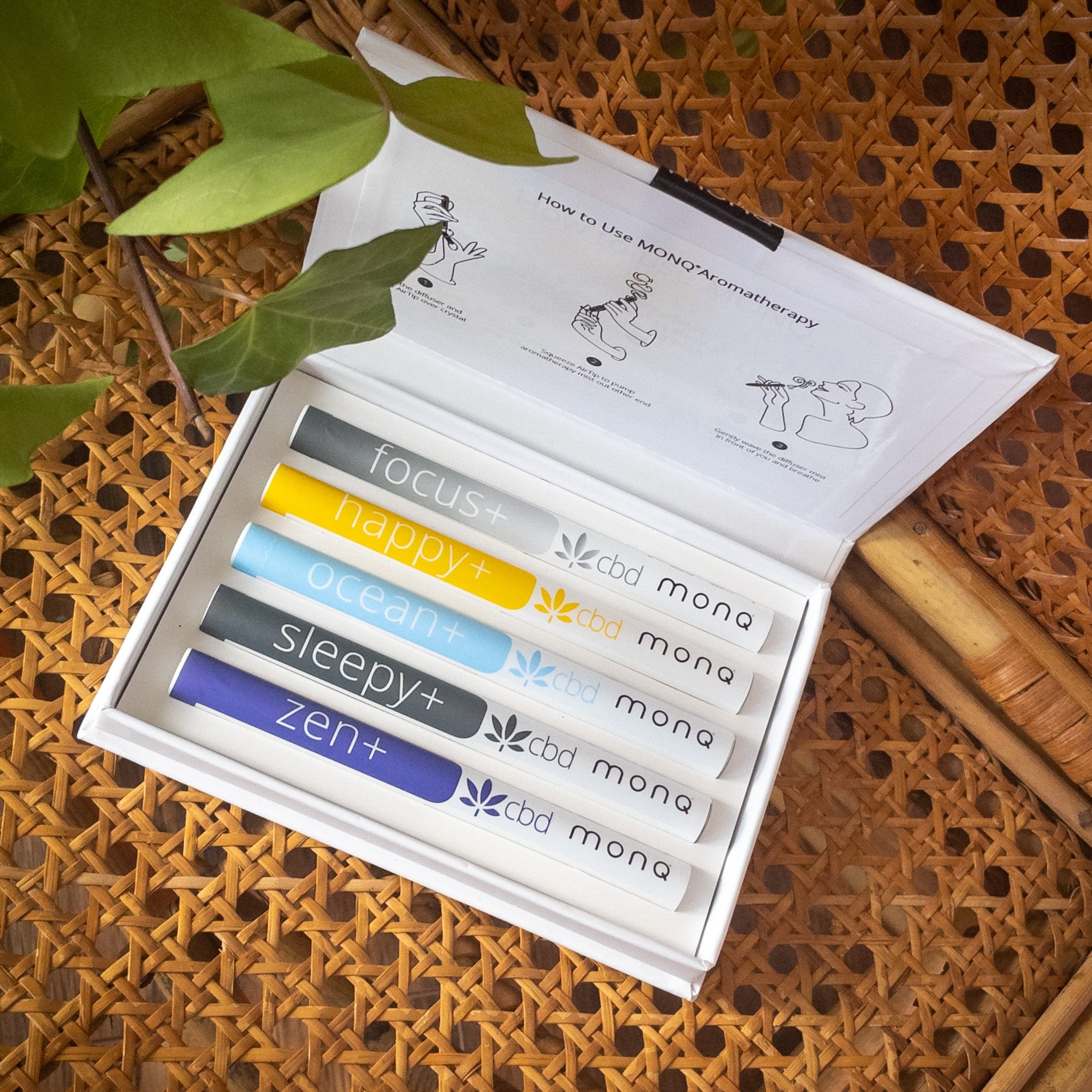
Adults who enjoy personal aromatherapy may choose to include a MONQ diffuser as one sensory marker. Focus MONQ highlights coffee, ginger, and rosemary in its aromatic profile. Choose according to your scent preferences and review the ingredient information before use.
Before using any MONQ product, read how to use a MONQ personal aromatherapy diffuser and the MONQ safety and usage guidance, including who should not use the products. MONQ diffusers should not be inhaled into the lungs. Draw gently into the mouth, then exhale through the nose.
The product’s role here is an optional aromatic experience, not intended as medical care, a stimulant replacement, or a guarantee of better cognitive performance.
Frequently Asked Questions
How can I focus while working when I keep getting interrupted?
Separate avoidable interruptions from required ones. Silence nonessential alerts, keep the current outcome visible, and record unrelated tasks instead of acting on them immediately. For required interruptions, leave a return note so you can reconstruct the task more easily.
What is a simple focus ritual?
Choose one outcome, clear the immediate workspace, begin a repeated cue, and start the smallest real action. The ritual can take only a few minutes and should remain simpler than the work it precedes.
How do I get into work mode at home?
Create a visible opening boundary: use a particular seat or light, set out the required materials, put away unrelated items, and write the first outcome. A consistent opening can help distinguish work time from the rest of home life.
What is a good caffeine-free focus routine?
Use adequate light, water, comfortable temperature, a defined task, and a repeatable beginning. Music, movement, a caffeine-free drink, or an optional aroma can be included according to preference. The routine does not need to reproduce the feeling of caffeine.
Do sensory cues improve focus?
A sensory cue can make a routine more recognizable and may acquire a personal association through repetition. That is different from proving that the cue directly improves concentration. Treat light, sound, texture, flavor, and aroma as contextual tools rather than guaranteed performance enhancers.
What should I do when I lose focus?
Notice the shift without turning it into a judgment. Record anything important that distracted you, reread the intended outcome, and complete one small next action. If your attention is depleted, a deliberate break may be more useful than repeatedly forcing a restart.
Start With a Better Beginning
You do not need to feel perfectly focused before meaningful work can begin.
Choose one visible outcome. Clear enough space to see it. Add a small cue you can repeat. Then start with the first real action.
When your attention moves (and it will), return to the outcome rather than starting the entire ritual again. A useful focus routine does not eliminate every interruption. It makes beginning, returning, and stopping more deliberate.
Research references
- Leroy, S. (2009). Why is it so hard to do my work? The challenge of attention residue when switching between work tasks. Organizational Behavior and Human Decision Processes, 109(2), 168–181.
- Mark, G., Gudith, D., & Klocke, U. (2008). The cost of interrupted work: More speed and stress. Proceedings of the SIGCHI Conference on Human Factors in Computing Systems, 107–110.
- Ward, A. F., Duke, K., Gneezy, A., & Bos, M. W. (2017). Brain drain: The mere presence of one’s own smartphone reduces available cognitive capacity. Journal of the Association for Consumer Research, 2(2), 140–154.
- Ruiz Pardo, A. C., & Minda, J. P. (2022). Reexamining the “brain drain” effect: A replication of Ward et al. (2017). Acta Psychologica, 230, 103717.
- Lally, P., van Jaarsveld, C. H. M., Potts, H. W. W., & Wardle, J. (2010). How are habits formed: Modelling habit formation in the real world. See UCL’s habit-formation research summary. European Journal of Social Psychology, 40(6), 998–1009.
IMPORTANT: MONQ diffusers are not intended for inhalation into the lungs. Gently draw into the mouth, then exhale through the nose. MONQ products are intended for adults 21 and older. Keep out of reach of children and pets. Consult a healthcare professional before use if you are pregnant, nursing, have a medical condition, or take medication. Stop use if irritation occurs.
These statements have not been evaluated by the Food and Drug Administration. This product is not intended to diagnose, treat, cure, or prevent any disease. No Nicotine Ever in MONQ Diffusers.










Leave a comment