Lemongrass Essential Oil Uses

What Is Lemongrass?
Lemongrass essential oil is steam-distilled from the long, blade-like leaves of Cymbopogon citratus or Cymbopogon flexuosus, tropical grass species native to South and Southeast Asia. Unlike citrus oils pressed from fruit peels, lemongrass produces its sharp, grassy-lemon aroma from the leaves and stalks of the plant - a scent that is brighter and more assertive than true lemon essential oil, with a herbal green quality that reflects its grass-family origins. Lemongrass has been central to Southeast Asian culinary, medicinal, and aromatic traditions for centuries.
In Thai, Vietnamese, Indonesian, and Indian cooking traditions, lemongrass stalks are a fundamental aromatic ingredient, contributing brightness and complexity to curries, soups, and marinades. In Ayurvedic practice, lemongrass was valued as a warming, clarifying herb used to support alertness and ease mental congestion. Across West Africa and the Caribbean, where lemongrass was introduced during the colonial period and quickly naturalized, it became known as "fever grass" and was woven into local healing traditions. The essential oil distilled from the fresh plant captures this diversity of cultural tradition in a single bright, invigorating aromatic profile.
Today, lemongrass essential oil is one of the most widely used botanicals in professional aromatherapy, household products, and natural wellness formulations. Its clean, assertive citrus-herbal character makes it immediately recognizable and consistently associated with freshness, clarity, and energizing uplift.
The Science Behind Lemongrass
The defining constituent of lemongrass essential oil is citral, a naturally occurring aldehyde that typically comprises 65-85% of the oil's composition. Citral itself is a mixture of two geometric isomers - geranial (citral A) and neral (citral B) - both of which contribute to the oil's characteristic sharp lemon character. Aldehydes are among the most potent aromatic molecules at activating olfactory receptors, which is why lemongrass has such an immediate and pronounced effect on sensory awareness. Even at low concentrations, citral engages the olfactory epithelium strongly, triggering rapid signal transmission to the brain's limbic system.
Beyond citral, lemongrass contains geraniol, limonene, myrcene, and beta-caryophyllene - a supporting cast of terpenes that adds complexity and depth to the oil's otherwise citral-dominant profile. The olfactory signal generated by lemongrass tends to be associated with alertness, spatial awareness, and a sense of clean mental clarity. This is consistent with lemongrass's traditional role as a stimulating, clarifying botanical across the many cultures that have incorporated it into wellness practice over centuries.
How MONQ Uses Lemongrass
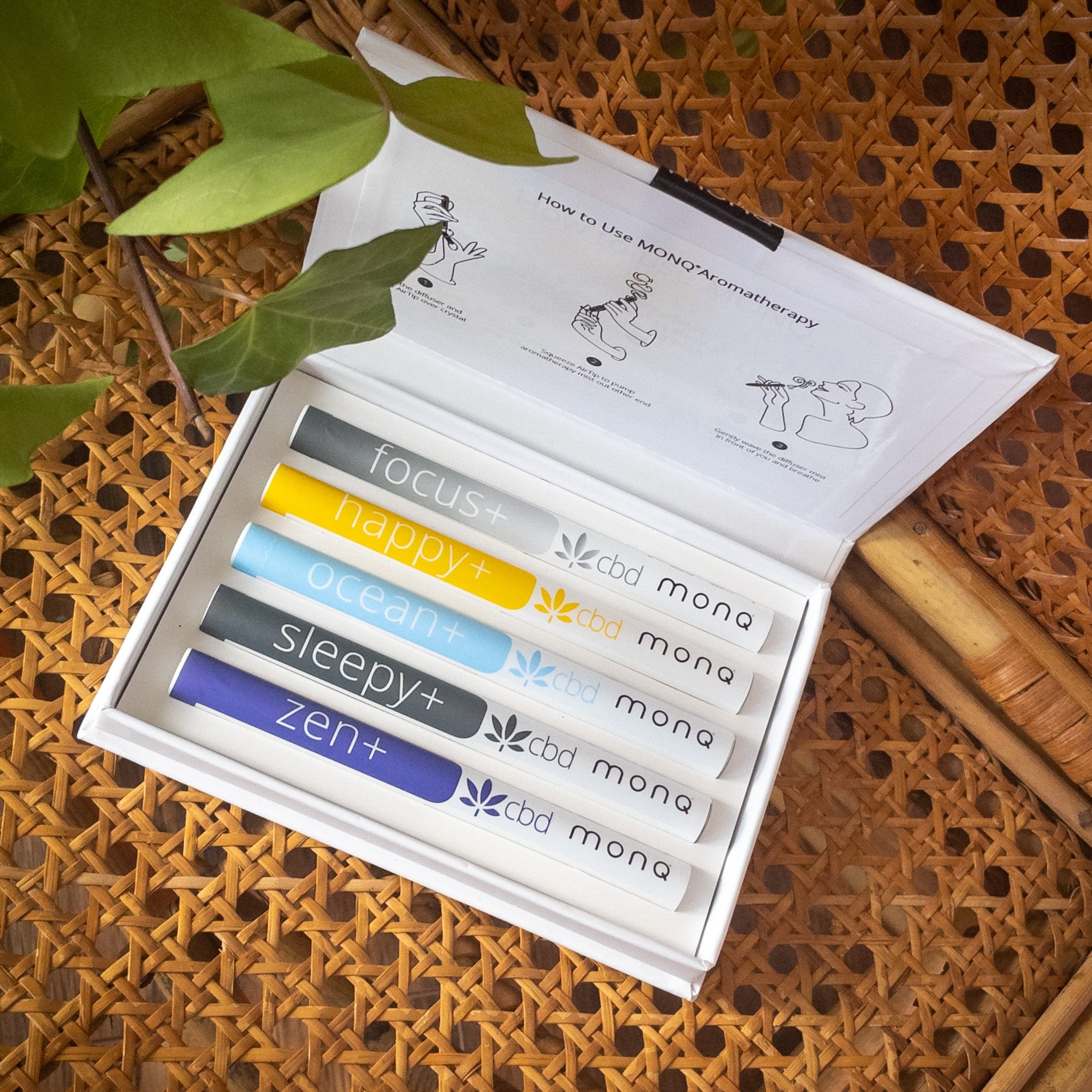
MONQ incorporates lemongrass essential oil in blends designed to support focused attention, mental clarity, and an uplifted, energized state of mind. Its high citral content makes it a strong top note in aromatic formulations - the first impression in a blend that sets the emotional direction before deeper botanical layers unfold. In Focus MONQ and related clarity-oriented blends, lemongrass contributes the bright, sharpening quality that signals to the brain: pay attention, engage, be present.
When you draw MONQ's aromatic mist through your mouth and exhale through your nose, lemongrass's aldehyde-rich molecules follow the direct olfactory route to your brain's limbic centers. The effect is immediate - a clean, bright aromatic shift that feels like opening a window on a clear morning. For moments when mental drift needs to be reversed or focus needs to be sharpened, lemongrass is one of the most direct botanical allies in MONQ's ingredient library.
Explore More
Disclaimer: The above information is provided for general wellness and educational purposes only. Please note that while individual essential oil ingredients may have been shown to exhibit certain independent effects when used alone, the specific blends of ingredients contained in MONQ diffusers have not been tested. No specific claims are being made that use of any MONQ diffusers will lead to any of the effects discussed above. Additionally, please note that MONQ diffusers have not been reviewed or approved by the U.S. Food and Drug Administration. MONQ diffusers are not intended to be used in the diagnosis, cure, mitigation, prevention, or treatment of any disease or medical condition. If you have a health condition or concern, please consult a physician or your alternative health care provider prior to using MONQ diffusers. MONQ blends should not be inhaled into the lungs. Why? It works better that way. No Nicotine Ever. Inhale through the mouth, exhale through the nose. MONQ Diffusers are not intended for individuals under 18, or women who are pregnant or nursing.