Cacao Essential Oil Uses

What Is Cacao?
Cacao (Theobroma cacao) - whose genus name means food of the gods in Greek - is a small tropical tree native to the deep tropical regions of Mesoamerica that has shaped human civilization more profoundly than almost any other plant. The Olmec people of present-day Mexico were among the first to cultivate and use cacao, with evidence of cacao processing dating back to 1500 BCE. The Mayans considered it sacred, using fermented cacao beverages in religious ceremonies, royal courts, and as currency. The Aztecs reserved it primarily for warriors, priests, and nobility, believing it to bestow courage, wisdom, and connection to the divine.
Cacao essential oil, extracted from the roasted cacao bean, captures the deep, rich, complex scent of true dark chocolate in botanical form - earthy, slightly bitter, warm, and deeply comforting. This is an oil whose aroma is almost universally associated with pleasure, reward, and emotional richness. When Spanish conquistadors brought cacao back to Europe in the 16th century, its transformation from bitter ceremonial beverage to sweetened luxury spread rapidly across every culture it touched, creating one of the most powerful universal positive scent associations in human history.
The aromatic signature of cacao essential oil is distinct from manufactured chocolate fragrance: it is earthier, more complex, with roasted and slightly fermented notes alongside the recognizable chocolate warmth. It is the kind of scent that speaks of depth and richness rather than sweetness alone - a botanical that carries centuries of human ceremony and pleasure in every breath.
The Science Behind Cacao
Cacao essential oil contains pyrazines, furans, aldehydes, esters, and a range of nitrogen-containing compounds that together produce its characteristic complex roasted-chocolate aroma. Pyrazines are the primary compounds responsible for the roasted, nutty dimension of chocolate's scent, formed during the fermentation and roasting process that converts raw cacao into aromatic raw material. These compounds engage olfactory receptors with particular efficiency, explaining why chocolate scents are perceived so vividly even at low concentrations.
The emotional response to cacao's aromatic profile is one of the most studied areas in sensory neuroscience, partly because chocolate represents such a cross-culturally powerful positive association. When cacao's aromatic compounds reach the limbic system via the olfactory pathway, they engage the brain's reward-circuitry and emotional memory networks with unusual directness. Research into food-associated scents has demonstrated that chocolate aroma in particular activates pleasure-associated neural networks and can shift mood states measurably in controlled conditions. Theobromine, present in trace amounts in cacao essential oil, contributes a gentle stimulating quality - the same compound responsible for chocolate's characteristic mild, sustained uplift when consumed - and through inhalation adds to cacao oil's overall aromatic experience of warmth, richness, and gentle positive activation.
How MONQ Uses Cacao
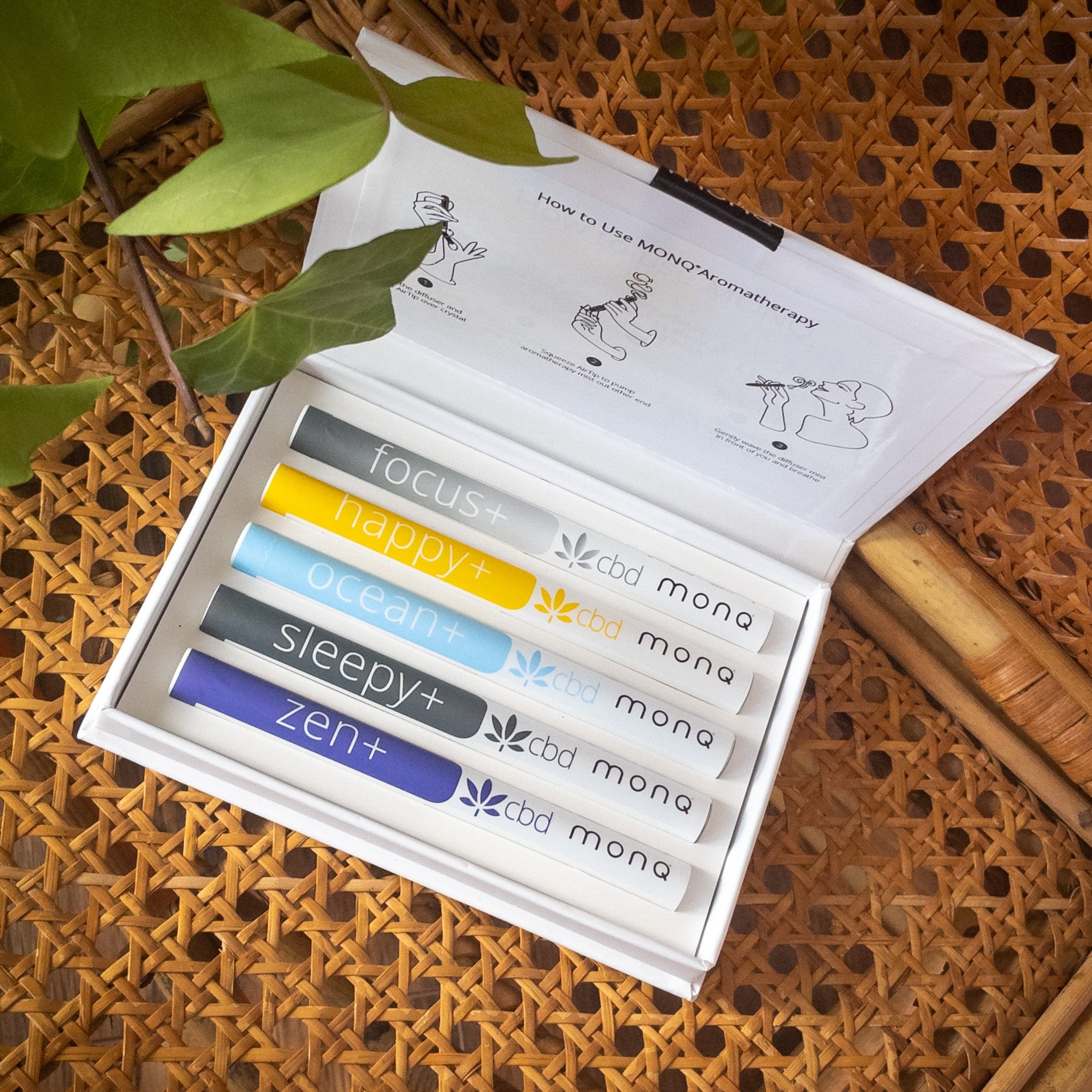
Cacao also appears in Cozy+CBD MONQ, where its warm, comforting character pairs perfectly with the CBD isolate and complementary botanicals to create an aromatic experience of genuine indulgence and ease.
MONQ's retronasal breath method - inhaling through the mouth, exhaling through the nose - allows cacao's complex pyrazine and aldehyde compounds to travel the full olfactory pathway, delivering their rich depth on the exhale. This mirrors, in a small and intentional way, the act of slowly savoring a piece of dark chocolate - an act of deliberate presence and sensory attention that has been a human pleasure for four thousand years. A few intentional breaths with a cacao-forward MONQ blend can serve as a brief, genuine ritual of self-care: a moment of warmth and richness carved out of whatever the day holds.
Explore More
Disclaimer: The above information is provided for general wellness and educational purposes only. Please note that while individual essential oil ingredients may have been shown to exhibit certain independent effects when used alone, the specific blends of ingredients contained in MONQ diffusers have not been tested. No specific claims are being made that use of any MONQ diffusers will lead to any of the effects discussed above. Additionally, please note that MONQ diffusers have not been reviewed or approved by the U.S. Food and Drug Administration. MONQ diffusers are not intended to be used in the diagnosis, cure, mitigation, prevention, or treatment of any disease or medical condition. If you have a health condition or concern, please consult a physician or your alternative health care provider prior to using MONQ diffusers. MONQ blends should not be inhaled into the lungs. Why? It works better that way. No Nicotine Ever. Inhale through the mouth, exhale through the nose. MONQ Diffusers are not intended for individuals under 18, or women who are pregnant or nursing.