

Embracing Mindfulness Every Day

Mindfulness serves as a gentle guide, urging us to tether ourselves to the now, enabling us to fully immerse in and appreciate the unfolding reality around us. Nevertheless, for many, the journey into mindfulness poses a challenge. Our bustling minds, accustomed to taking center stage, may resist the discipline required for mindfulness practice. This resistance is entirely normal and an integral part of the learning process. Remember, mindfulness is not a destination but a practice, a conscious effort to rewire our brains.
Managing Stress Naturally
Cultivating mindfulness is akin to taming a spirited horse; it takes patience and a compassionate approach. Rather than succumbing to frustration, view it as an opportunity for self-compassion. Picture consoling a dear friend facing life's challenges and extend the same empathetic sentiments to yourself during moments of mindfulness practice.
Identifying when to offer ourselves compassion is key. If you catch yourself criticizing or feeling frustrated, pause and shift your inner dialogue, drawing inspiration from how you would comfort a friend. In moments of wandering thoughts during mindfulness, approach your mind with kindness, as you would gently guide a child back to a task at hand.
Another opportune time for self-compassion arises during a mindfulness check-in - a brief moment for a deep breath and a personal emotional inventory. This need not be confined to stillness; it can occur while walking between commitments. Become an impartial observer, noting your present feelings without judgment. If fatigue surfaces, resist the urge to admonish yourself. Instead, choose a compassionate response, perhaps opting for deep breaths or a rejuvenating walk.
When practicing self-compassion, avoid the common instinct to push through challenges with phrases like "tough it out" or "be strong." Mindful kindness encourages a more understanding dialogue, considering compassionate solutions and recognizing your needs. Take time to soothe yourself during this important practice. Even outside formal sessions, show yourself kindness. Regular check-ins and moments of self-compassion can fortify you through the learning curve, reminding you that life's struggles are not punishments but challenges to be met with care.
Mindful kindness doesn't erase problems, but it acknowledges personal suffering and explores solutions. It swaps self-judgment for self-compassion, fostering awareness of ways to assist yourself. Suppressing challenging emotions only heightens stress responses, so be present for yourself, cultivating awareness, compassion, and solutions - one kind, mindful moment at a time.
Micro-Practices for Everyday Mindfulness
Formal meditation sessions are valuable, but mindfulness is most durable when it lives in the gaps of ordinary life. A few micro-practices that work well in real conditions:
Body scan at transitions. When moving from one task to the next, pause for 30 seconds. Notice three points of physical sensation without trying to change them. This brief check-in interrupts automatic pilot and returns awareness to the present moment.
Breath as a micro-anchor. One conscious breath with a slightly longer exhale than inhale activates the parasympathetic nervous system. It takes less than five seconds and can be done anywhere, including mid-meeting.
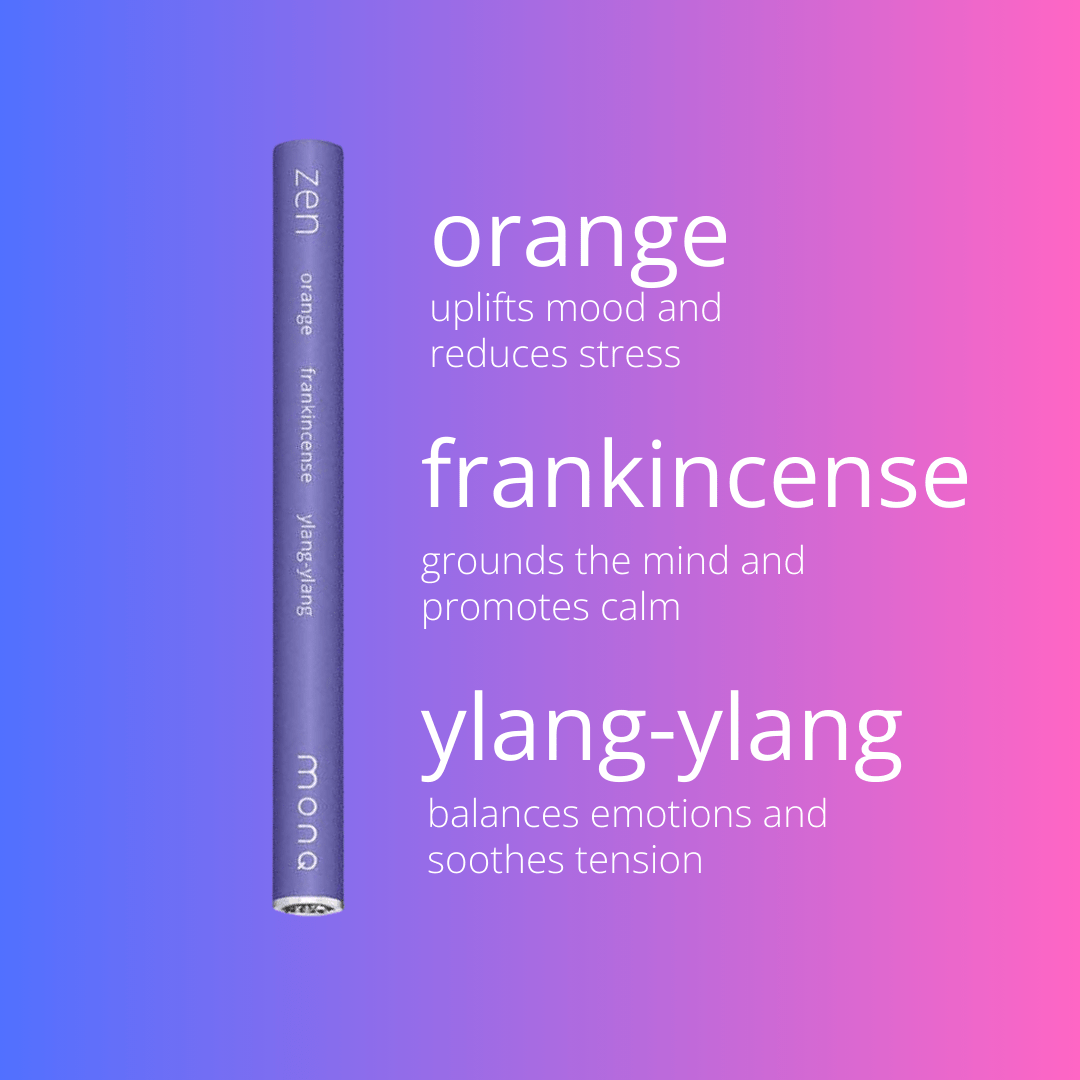
Sensory anchoring with scent. Scent is one of the most powerful present-moment anchors because it bypasses cognitive processing entirely. Where vision and sound are first filtered by the cortex, olfactory signals travel directly to the limbic system, the brain's emotional center. A familiar botanical scent can return you to a calm, present state faster than almost any other sensory input. Zen MONQ, with its frankincense, orange, and ylang-ylang formula, can serve as a ritual anchor for mindfulness moments: the same scent, used consistently, builds a conditioned association with the settled awareness you are practicing.
Go Deeper
Scent is one of the most powerful anchors for present-moment awareness because it bypasses cognitive processing entirely, landing directly in the brain's emotional and memory centers. That makes it a natural complement to the mindfulness practices explored here.
Aromatherapy for Stress: How Scent Calms the Body's Stress Response →Disclaimer: The above information is provided for general wellness and educational purposes only. Please note that while individual essential oil ingredients may have been shown to exhibit certain independent effects when used alone, the specific blends of ingredients contained in MONQ diffusers have not been tested. No specific claims are being made that use of any MONQ diffusers will lead to any of the effects discussed above. Additionally, please note that MONQ diffusers have not been reviewed or approved by the U.S. Food and Drug Administration. MONQ diffusers are not intended to be used in the diagnosis, cure, mitigation, prevention, or treatment of any disease or medical condition. If you have a health condition or concern, please consult a physician or your alternative health care provider prior to using MONQ diffusers. MONQ blends should not be inhaled into the lungs. Why? It works better that way. No Nicotine Ever. Inhale through the mouth, exhale through the nose. MONQ Diffusers are not intended for individuals under 18, or women who are pregnant or nursing.










Leave a comment