

Paleo Air: The Japanese Forest Bathing Research That Changed Everything
In the last email, I introduced the idea of “Paleo Air” — the notion that we evolved breathing a rich mix of botanical compounds, and that modern life has quietly cut us off from them.
What I didn’t tell you is how I found the evidence.
A Japanese Government Research Program, Started in the 1980s
In 2014, I came across research on a Japanese practice called shinrin-yoku — forest bathing. Not hiking. Not exercising in the woods. Just being there. Breathing.
The Japanese government had been funding studies on it since the 1980s, and what they found was extraordinary: spending time breathing forest air measurably reduced cortisol, lowered blood pressure, and boosted natural killer cell activity. Not by a little. By a lot.
The question that fascinated me was: why?
The Answer Was the Air Itself
The answer turned out, largely, to be the air itself. Trees — especially conifers like pine, cedar, and cypress — release volatile organic compounds called terpenes. Alpha-pinene. Beta-pinene. Limonene. These aren’t just “scents.” They’re bioactive molecules that your olfactory system evolved to interact with over hundreds of thousands of years.
When you walk through a pine forest, you’re not just smelling something pleasant. You’re breathing in a pharmacological cocktail that your nervous system recognizes at a primal level.
The Insight That Led to Forest MONQ
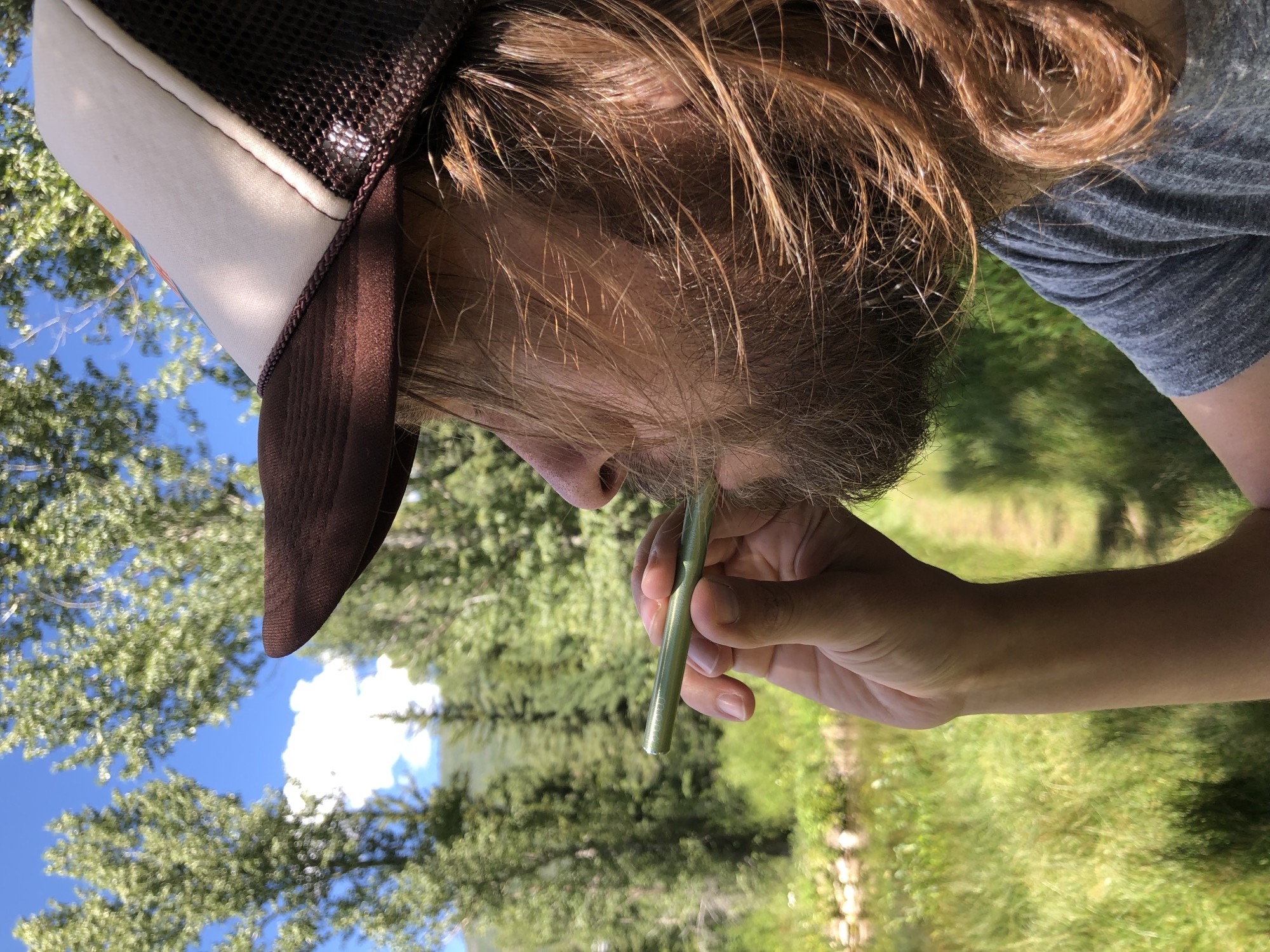
If the science showed that breathing specific botanical compounds produced real physiological changes — and if those compounds could be identified and blended — then maybe you didn’t need to live next to a forest to get the benefit. You could carry the forest with you.
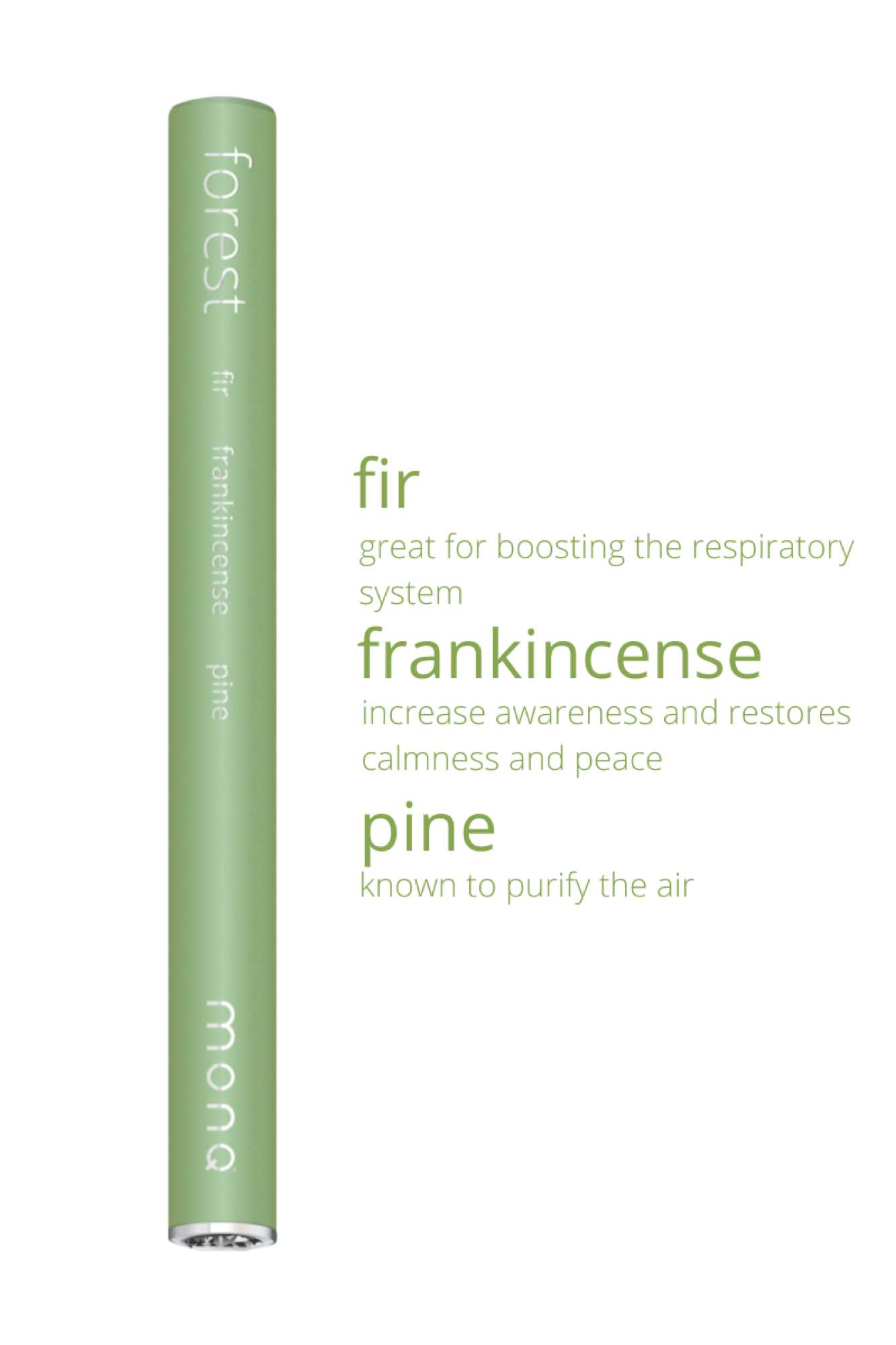
That insight is what led directly to Forest MONQ. We blended essential oils containing alpha-pinene, beta-pinene, and other terpenes found in coniferous forests into a single portable diffuser. The same compounds the Japanese researchers measured in the air of Yakushima and Akasawa. Concentrated, portable, and available in a single breath.
What the Research Actually Shows
The Japanese studies documented specific, measurable outcomes from time spent breathing forest terpenes:
- Cortisol reduction (the primary stress biomarker)
- Normalized blood pressure
- Increased natural killer (NK) cell activity — the immune cells responsible for fighting infections and abnormal cells
- Improved mood and reduced stress scores
These effects weren’t explained by exercise, visual scenery, or “relaxation” alone. Control studies showed that the terpene-rich air itself was the active variable.
Carrying the Forest With You
MONQ isn’t a replacement for a walk in the woods. Nothing is. But for the 22 hours a day most of us spend indoors, it’s the closest thing we’ve been able to build.
If you’re curious: forest bathing at home — the original blend. Or personal aromatherapy diffusers. And for those drawn to grounded, earthy botanicals: grounding botanical blends inspired by conifer forests.
The Japanese researchers who spent forty years studying shinrin-yoku weren’t studying relaxation. They were studying what happens when a body finally receives what it evolved to need.
That’s the question worth asking. Not “is nature pleasant?” But: “what have we been missing?”
Research cited:
Li Q et al. — Effects of Shinrin-yoku on health promotion and disease prevention — Environ Health Prev Med, 2022
Li Q et al. — Forest park exposure increases human natural killer activity — J Biol Regul Homeost Agents, 2010
Li Q & Kawada T — Effect of forest environments on human NK activity — Int J Immunopathol Pharmacol, 2011
Terpene deficiency and Paleo Air — the missing piece of modern wellness — MONQ
Balsam fir essential oil — phytoncide aromatics from the northern forest — MONQ Ingredient Library
These statements have not been evaluated by the Food and Drug Administration. This product is not intended to diagnose, treat, cure, or prevent any disease. No Nicotine. Ever.













Leave a comment