

Patchouli: The Golden Aroma's Historical Voyage

A Whiff of Luxury from Distant Shores
Patchouli's signature scent is immediately recognizable - musky, deep, and earthy. Once a simple packing material for precious fabrics, its aroma soon became synonymous with luxury in Victorian England. Native to India and Malaysia, the dried patchouli leaves served as nature's protector, safeguarding delicate silks and cashmeres on their voyage to distant lands.
The story of how a protective botanical became one of the world's most iconic fragrances is a story about trade routes, cultural exchange, and the way that certain scents become embedded in collective memory. Patchouli didn't become famous because someone decided to market it. It became famous because every person who encountered it on a bolt of precious fabric found something in its earthy depth that they couldn't forget.
Tracing Patchouli's Footsteps Through History
The footprints of patchouli meander through time, from the gardens of Southeast Asia to the tombs of Egyptian pharaohs like King Tut. In China, its early medicinal applications evolved into protective wraps for silks, ensuring their pristine condition upon reaching Middle Eastern bazaars. And as the British Empire cast its wide net, the scent of patchouli wafted through the European aristocracy, becoming an emblem of affluence and sophistication. Today, with its tropical lineage, patchouli thrives in countries like Malaysia, Brazil, China, and India.
In Indian Ayurvedic medicine, patchouli - known as "Pacholi" - was used for centuries as a grounding botanical, an aphrodisiac, and a remedy for skin conditions. Ancient Indian texts reference its use in preparations meant to support emotional stability and vitality. In China, it was known as "guang huo xiang" and was used in formal medicine for digestive support and protection against environmental challenges.
The Meiji era in Japan saw patchouli used as a protective treatment for silk kimono fabrics - a practice that mirrors its earlier role in the Silk Road trade. In each culture, the recognition was similar: this plant has something that protects, grounds, and endures.
By the 19th century, patchouli had become so associated with authentic Eastern textiles that European buyers regarded it as a mark of legitimacy. Fabrics that lacked the scent were sometimes viewed with suspicion. Perfumers in Paris and London began incorporating it into prestige fragrances, and within a generation, patchouli had moved from protective packaging to one of the most valued notes in high perfumery.
The Aromatic Ensemble
Eight key terpenes contribute to the unique aromatic profile of patchouli essential oil. From alpha-bulnesene's woody depth to beta-caryophyllene's sweet, slightly spiced undertones, these compounds work in concert to produce a scent that is genuinely complex. Unlike many essential oils whose aromatic profile is dominated by one or two compounds, patchouli's character emerges from the interplay of multiple constituents.
Patchoulol - the primary sesquiterpene alcohol in the oil - is responsible for the characteristic earthy, musky base note that defines patchouli. It's also one of the reasons that patchouli actually improves with age: patchoulol deepens and becomes richer when the oil is stored properly, which is why aged patchouli is highly prized in the fragrance industry.
Versatile Uses of Patchouli Oil
Patchouli's applications are as varied as its history. From ancient times, its aromatic profile has doubled as an insect repellent - one of the earliest documented uses - a tradition that continues today in natural pest deterrents. But the more compelling applications have always been in fragrance, mood support, and personal wellness.
Aromatherapy Benefits and Mood Effects
In aromatherapy practice, patchouli is classified as a grounding and calming oil - one that works specifically to reduce the agitation and scattered quality of an overactive nervous system. When the mind is running ahead of the moment - planning, worrying, reviewing - patchouli's earthy depth acts as a counterweight. Its scent signals: you are here, in this body, in this moment.
Research on patchouli's aromatic compounds has found that patchoulol and other sesquiterpenes may interact with serotonin receptors and support mood stability. While more research is needed to establish clinical protocols, the traditional and anecdotal evidence across multiple cultures consistently points toward the same applications: patchouli calms, grounds, and stabilizes emotional states.
Its aphrodisiac reputation - which spans ancient India, Egypt, the Victorian era, and the 20th century counterculture - is almost certainly rooted in this grounding quality. True presence is attractive. The ability to be fully in the moment, fully in your body, fully available - that's what patchouli has historically been used to cultivate.
Grounding Properties
Of all the botanical categories in aromatherapy, "grounding" oils are among the most practically useful. We live in an era of chronic mental overstimulation - screens, notifications, competing demands - and the nervous system pays a price. Grounding aromatherapy provides a direct, fast-acting counterweight to this constant forward-pulling stimulation.
Patchouli is one of the most effective grounding oils available. Its earthy, deep, complex scent profile activates the parasympathetic nervous system - the branch that promotes rest, digestion, and recovery. It doesn't sedate. It settles. There's a difference between being slowed down and being brought into the present moment, and patchouli consistently delivers the latter.
Historical Use as Aphrodisiac
Patchouli's aphrodisiac reputation is ancient and cross-cultural - not a modern marketing claim but a documented tradition that predates commercial perfumery by thousands of years. In Indian Ayurvedic texts, in Egyptian royal preparations, in the sensory vocabulary of every culture that encountered the plant in its native region, patchouli was associated with desire, intimacy, and romantic attraction.
The mechanism is likely grounding rather than hormonal: patchouli's effect on the nervous system promotes the parasympathetic state of presence and ease that makes genuine intimacy possible. It removes the mental barrier - the constant background activity of the overstimulated mind - and replaces it with embodied presence. In that state, connection becomes natural.
Patchouli in Aromatherapy Today
Modern aromatherapy has rediscovered and validated much of what traditional medicine always knew about patchouli. Today it's used extensively in personal diffusers, meditation practices, mindfulness rituals, and therapeutic blending. Its applications extend from the deeply personal - intimate rituals, grounding practices - to the broadly accessible: it's an oil that works for everyone who encounters it, even if it takes a moment to settle into its depth.
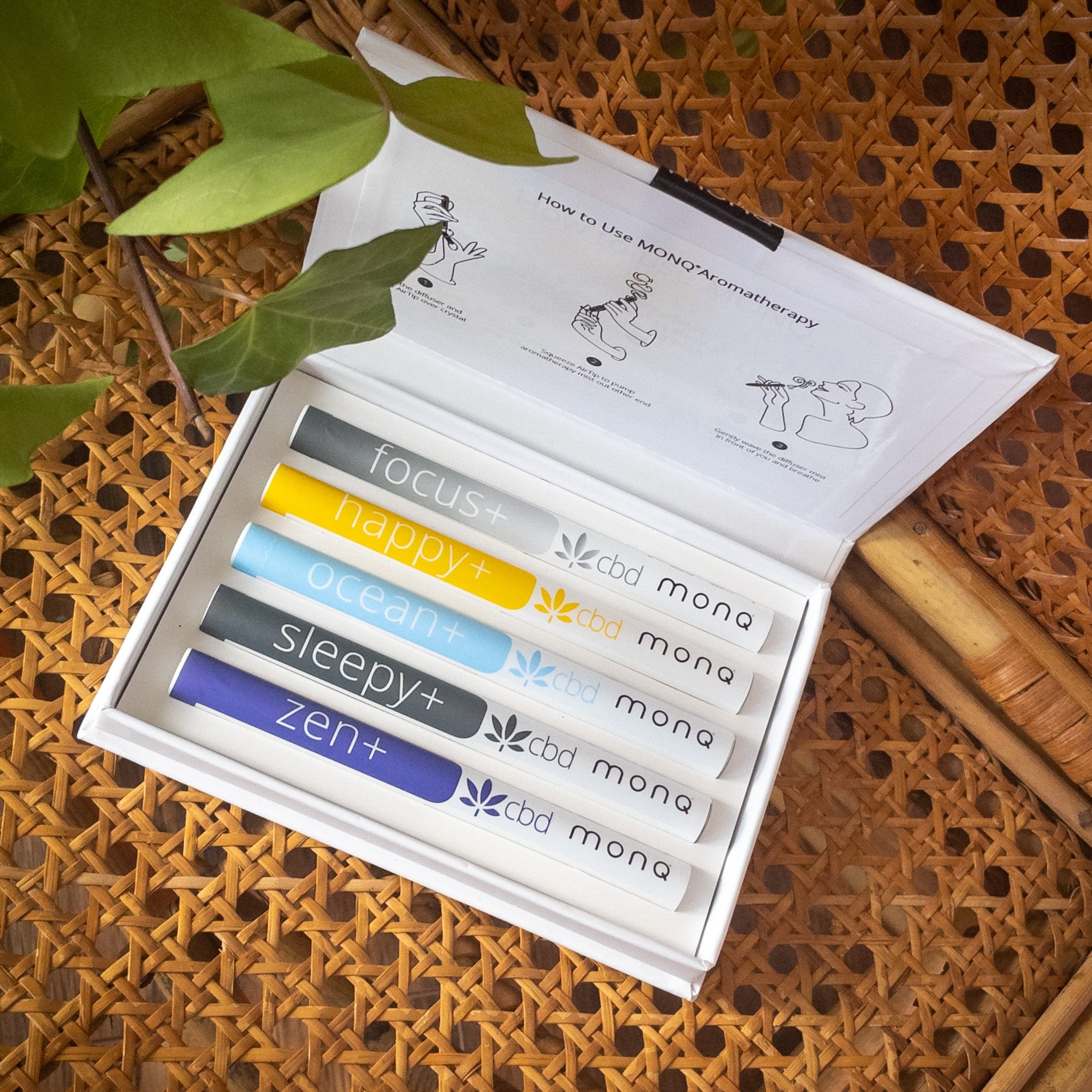
The personal aromatherapy diffuser format - pioneered by MONQ in 2014 - is an ideal delivery method for patchouli specifically. The mouth-to-nose technique puts the aromatic compounds directly through the olfactory pathway to the limbic brain, where patchouli's grounding and mood-supportive effects are most directly processed. Two or three intentional breaths with a patchouli-containing blend creates a measurable shift in nervous system state: from scattered to present, from anxious to settled, from performing to inhabiting.
In mindfulness rituals, patchouli serves as an anchor: a consistent sensory signal that tells the nervous system it's time to arrive. Used repeatedly in meditation or breathwork practice, its grounding quality becomes associated with the state of practice itself - making it easier over time to access that state with less effort. This is the principle of scent memory, and patchouli's distinctive and memorable aroma makes it particularly effective for this purpose.
Patchouli and Sexy MONQ
Patchouli is one of three essential oils in Sexy MONQ, alongside cinnamon leaf essential oil and jasmine absolute. Together, these three botanicals have been used in sensuality, attraction, and intimate ritual across multiple cultures and thousands of years. Patchouli's role in the blend is to anchor and deepen: it's the bass note that gives Sexy MONQ its staying power and the earthy groundedness that keeps the whole composition from being purely sweet or purely spiced.
Sexy MONQ is part of THE RETURN - MONQ's restoration of its most beloved retired blends. If you've been looking for patchouli in a personal aromatherapy format, this is the blend built around it.
Disclaimer: The above information is provided for general wellness and educational purposes only. Please note that while individual essential oil ingredients may have been shown to exhibit certain independent effects when used alone, the specific blends of ingredients contained in MONQ diffusers have not been tested. No specific claims are being made that use of any MONQ diffusers will lead to any of the effects discussed above. Additionally, please note that MONQ diffusers have not been reviewed or approved by the U.S. Food and Drug Administration. MONQ diffusers are not intended to be used in the diagnosis, cure, mitigation, prevention, or treatment of any disease or medical condition. If you have a health condition or concern, please consult a physician or your alternative health care provider prior to using MONQ diffusers. MONQ blends should not be inhaled into the lungs. Why? It works better that way. No Nicotine Ever. Inhale through the mouth, exhale through the nose. MONQ Diffusers are not intended for individuals under 18, or women who are pregnant or nursing.










Leave a comment