

Patchouli: The Earthy Scent of Calm and Balance
Patchouli essential oil has a rich, musky, and earthy aroma that has been prized for centuries in perfumes, incense, and holistic healing. It's particularly well known for its grounding and calming properties, making it a favorite in meditation and relaxation practices. But there is far more to this remarkable oil than its singular scent - patchouli carries with it thousands of years of human history, a complex chemistry, and a quietly compelling body of research into its wellness applications.
What Is Patchouli?
Patchouli (Pogostemon cablin) is a bushy herb in the mint family (Lamiaceae), native to tropical regions of Asia - particularly the Philippines, Indonesia, India, and China. The plant grows to about three feet tall, with soft, fragrant leaves and small pink-white flowers. Unlike many essential oils, patchouli actually improves with age: the oil darkens and its complexity deepens over years of storage, which is part of why vintage patchouli is particularly prized by perfumers.
The essential oil is extracted from the dried leaves and stems of the patchouli plant through steam distillation. It takes a significant amount of plant material to produce each small bottle of oil, which is one reason why pure patchouli has historically been considered a luxury ingredient. The resulting oil is a rich, dark amber or brown in color, with a viscous texture and a scent that is unmistakable once you know it.
The Aromatic Character of Patchouli
Patchouli has one of the most polarizing scent profiles in aromatherapy - people either love it immediately or need to grow into it. Its aromatic character is layered and complex:
- Top notes: A slightly sharp, earthy, and green opening with faint camphoraceous hints
- Heart notes: Rich, warm, and musky - deeply earthy with sweet undertones
- Base notes: Dark, heavy, woody depth that lingers for hours - the signature patchouli note
The primary chemical constituents of patchouli oil include patchoulol, alpha-patchoulene, seychellene, norpatchoulenol, and alpha-bulnesene. Patchoulol (also called patchouli alcohol) is the dominant sesquiterpene responsible for the characteristic earthy, musky scent and is the compound most extensively studied for its biological properties.
In perfumery, patchouli functions as a fixative base note - it anchors lighter aromatic ingredients and extends the longevity of a fragrance. This is why patchouli appears as a foundational note in so many luxury perfumes, from classic French fragrances to modern niche perfumery. Blended with bergamot, lavender, or frankincense, patchouli transforms from raw and earthy to deeply sophisticated.
Patchouli Through History
The story of patchouli's journey from Southeast Asian forests to global cultural icon is genuinely fascinating. For centuries, patchouli was used throughout Asia as a medicinal herb and a protective aromatic. In India, dried patchouli leaves were packed between bolts of precious silk and cashmere shawls to deter moths during the long trade routes from India to Europe - which is why, for generations of Europeans, the distinctive smell of patchouli became synonymous with authentic Indian textiles.
By the 19th century, patchouli had become fashionable in European society. Empress Josephine of France was said to be fond of it, and the Victorians used it extensively in potpourri and personal grooming products. Then came the 1960s, when patchouli became one of the defining scents of the counterculture movement - earthy, untamed, and deliberately anti-establishment. This association has followed patchouli into the modern era, which tends to make people underestimate how sophisticated and complex the oil actually is when encountered in quality aromatherapy formulations.
The Wellness Applications of Patchouli
Beyond its remarkable history as a fragrance, patchouli has earned a sustained place in wellness traditions for good reason. Here is what traditional use and modern research suggest about its properties:
Grounding and Emotional Balance
In aromatherapy, patchouli is most celebrated for its grounding, centering, and stabilizing influence on mood and emotional state. It is frequently recommended for people who feel scattered, overwhelmed, disconnected from their physical body, or emotionally unmoored. The earthy, heavy nature of patchouli's scent is thought to anchor awareness in the present moment - which is why it is so commonly incorporated into meditation and mindfulness practices.
Skin Wellness
Patchouli has a long history of use in skin care traditions across Asia and Europe. Traditional preparations used it for dry, cracked, or aging skin - and many modern cosmetics still rely on patchouli as a skin-supporting ingredient. While specific skincare claims require clinical substantiation, the traditional use of patchouli in skin formulations reflects its long-recognized affinity for skin wellness.
Aphrodisiac Tradition
Across cultures from India to ancient Egypt, patchouli has been associated with sensuality, attraction, and romantic connection. The warm, musky depth of its scent profile is often described as inherently sensual - grounding in a way that invites presence and connection rather than withdrawal. The Sexy MONQ blend incorporates patchouli for precisely this reason, as part of a thoughtfully curated aromatic experience designed to create warmth and ease.
Meditation and Mindfulness
Patchouli's grounding qualities make it particularly well-suited to meditation practice. Many meditation traditions use incense containing patchouli to help practitioners move out of mental chatter and into physical, present-moment awareness. If you find your mind drifting during meditation or breathwork, incorporating patchouli aromatherapy into your practice can provide a sensory anchor that draws attention back to the body and the breath.
Patchouli in MONQ Blends
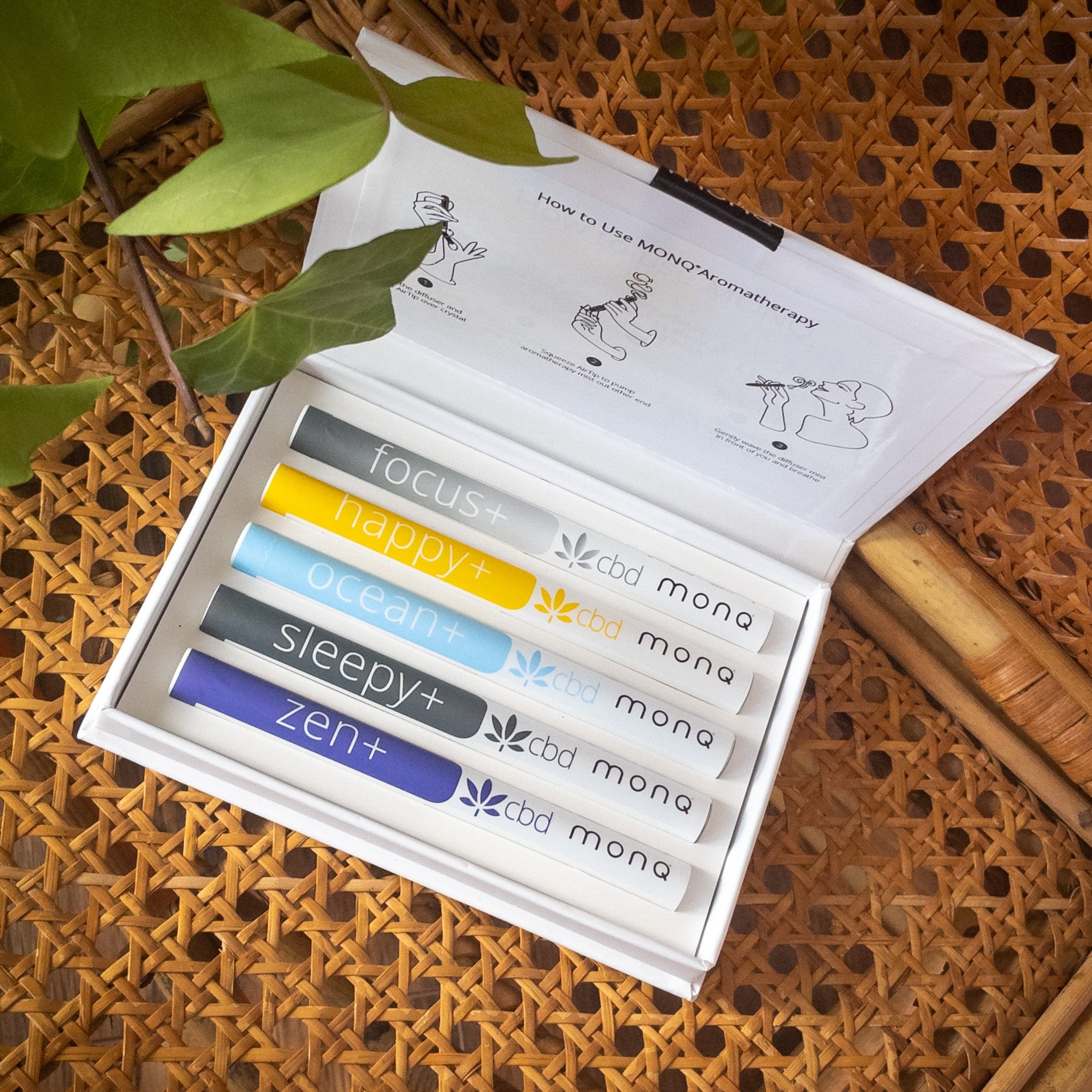
MONQ's personal aromatherapy diffusers are built on the principle of synergy - combining complementary essential oils to create effects that are greater than any single oil could produce alone. Patchouli, with its rich sesquiterpene profile and fixative qualities, is a natural candidate for grounding and calming blends.
MONQ founder Dr. Eric Fishman, MD, identified terpene deficiency as a core wellness challenge of modern life: most people are chronically deprived of the aromatic terpenes that their bodies evolved alongside in natural environments. Patchouli, with its dense concentration of sesquiterpenes like patchoulol, directly addresses this deficiency in the grounding, earthen register of the aromatic spectrum.
If you are drawn to patchouli's earthy, centering qualities, patchouli-centered aromatherapy can offer a grounded aromatic experience for moments of calm and reflection.
How to Use Patchouli for Maximum Benefit
Whether you encounter patchouli through a MONQ personal aromatherapy diffuser or through other aromatherapy applications, a few principles maximize its effectiveness:
- Use it intentionally: Patchouli is most effective when used with intention - create a moment of pause, breathe slowly, and allow the scent to anchor your attention in the present.
- Layer it thoughtfully: Patchouli blends beautifully with floral oils like jasmine and rose, with resins like frankincense, and with citrus oils like bergamot. It is less commonly paired with fresh, green, or aquatic scents.
- Give it time: Patchouli's aroma evolves considerably on the skin and in the air. The dry-down is often more complex and appealing than the initial impression, so let it breathe.
The Enduring Appeal of Patchouli
Patchouli is one of those rare botanical ingredients that seems to defy the passage of time. Every generation rediscovers it, sometimes in reaction against the previous generation's relationship with it - and yet it persists. There is something in its earthy, root-deep aroma that speaks to something fundamental in human experience: the desire to be grounded, present, and connected to the world of living things.
In a wellness context, patchouli offers a simple but profound invitation: to slow down, to breathe deeply, and to feel - for just a moment - the solid, ancient earth beneath your feet.
Disclaimer: The above information is provided for general wellness and educational purposes only. Please note that while individual essential oil ingredients may have been shown to exhibit certain independent effects when used alone, the specific blends of ingredients contained in MONQ diffusers have not been tested. No specific claims are being made that use of any MONQ diffusers will lead to any of the effects discussed above. Additionally, please note that MONQ diffusers have not been reviewed or approved by the U.S. Food and Drug Administration. MONQ diffusers are not intended to be used in the diagnosis, cure, mitigation, prevention, or treatment of any disease or medical condition. If you have a health condition or concern, please consult a physician or your alternative health care provider prior to using MONQ diffusers. MONQ blends should not be inhaled into the lungs. Why? It works better that way. No Nicotine Ever. Inhale through the mouth, exhale through the nose. MONQ Diffusers are not intended for individuals under 18, or women who are pregnant or nursing.










Leave a comment