

Why Your Bedtime Routine Needs Aromatherapy
Most people approach a difficult night the same way: lie down, close your eyes, wait. And then: check the clock, shift position, run through the mental checklist, wait some more. What's missing isn't more effort. It's a signal - a reliable, embodied cue that tells the nervous system it's safe to let go.
Aromatherapy provides exactly that signal, and it does it through the fastest sensory pathway in the brain.
The Problem With Trying Harder
Sleep is not something you do. It's something that happens when conditions are right. The more active effort you bring to trying to sleep, the more you activate the alert, effortful mode that makes sleep harder to reach. What works instead is behavioral cueing - using consistent environmental signals to train your nervous system to associate a set of circumstances with rest.
Scent is the most powerful behavioral cue available, precisely because it bypasses the rational mind. You can't decide your way into relaxation. But a familiar calming scent, encountered at the same point in the same sequence every night, triggers the limbic system directly - the part of the brain that actually governs the shift from alertness to rest.
Scent as a Behavioral Cue: The Science
Olfactory memory is uniquely durable. The olfactory bulb connects directly to the hippocampus and amygdala. This is why a scent can transport you instantly to a specific memory or emotional state with no reasoning required.
When you use the same calming scent consistently at bedtime, you're building an association. The scent becomes linked to the context of winding down. Over time, it becomes a trigger: encounter the scent, and the relaxation response begins to engage, even before any other wind-down behavior has taken place.
This is the ritual conditioning thesis behind Sleepy MONQ - that repeated breath plus scent plus consistent context creates progressively faster access to a calmer state. The first few nights, the effect is mild. After a month of consistent use, the scent alone begins to initiate the shift. The Sleep Foundation notes that consistent pre-bed routines are one of the most well-supported behavioral approaches to improving sleep quality.
Portable Aromatherapy vs. Room Diffusers: Which Is Right?
Room diffusers create an ambient scent environment throughout your wind-down space. An ultrasonic or cold-mist diffuser running lavender and cedarwood for 30 minutes before bed gradually fills the room with calming aromatics. The passive, ambient quality is part of its effectiveness - the scent is just there, doing its work in the background.
Room diffusers work best when you have a stable home environment and a consistent bedroom routine. Their limitation is portability: they don't travel well, and unfamiliar spaces can undermine the conditioning you've built at home.
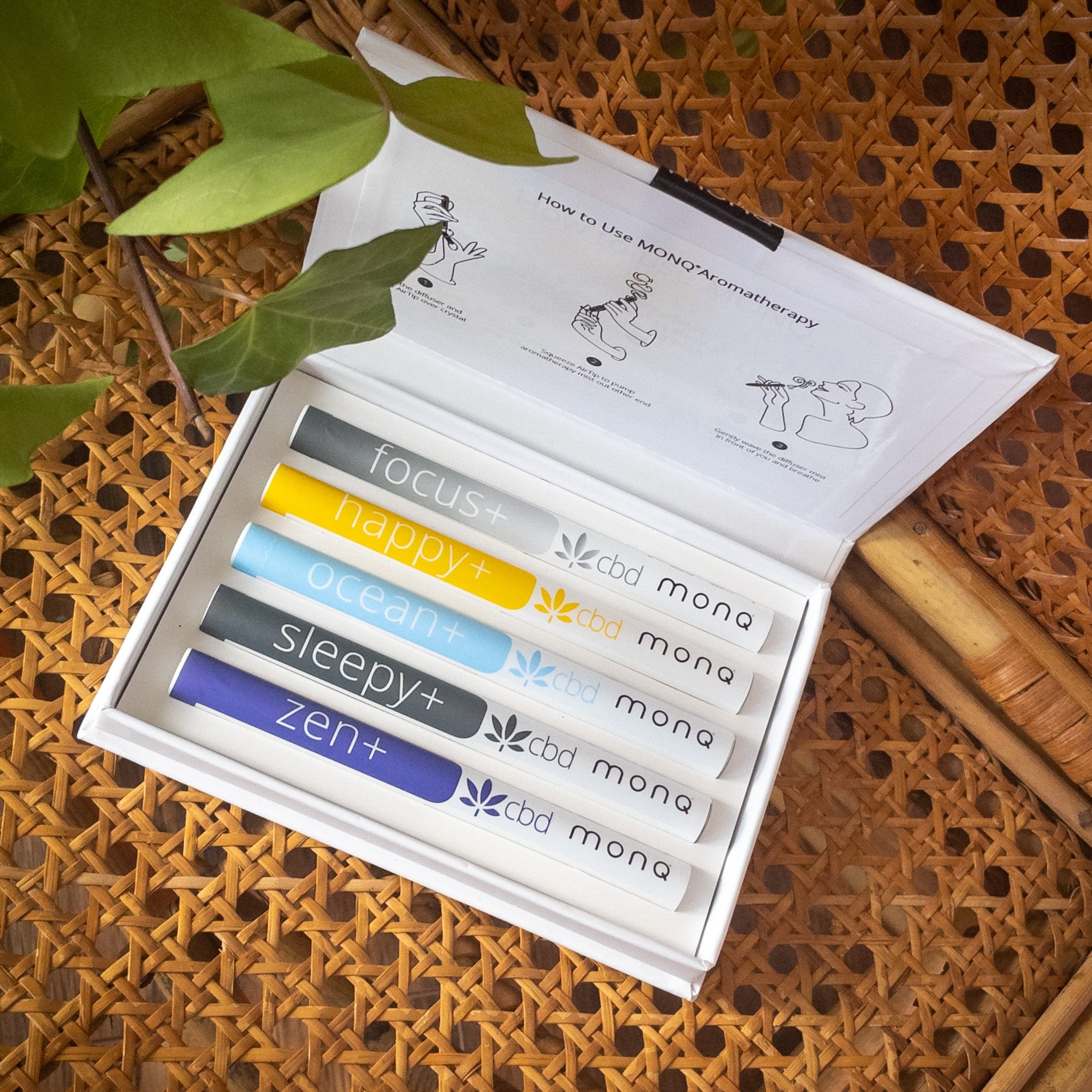
Portable personal aromatherapy addresses this limitation. Sleepy MONQ is a pen-sized personal diffuser you can keep on your nightstand, in a travel bag, or in your pocket. Inhale gently through the mouth, exhale through the nose. Aromatic molecules travel the retronasal olfactory pathway, engaging the limbic system with a concentrated botanical signal.
The portable approach offers two advantages: first, it's available anywhere, maintaining ritual continuity even in unfamiliar environments. Second, the intentional, breath-focused act itself is a form of slow breathing practice, which has its own relaxation benefits independent of the aromatics.
Many people find the best approach combines both: a room diffuser for ambient atmosphere and MONQ's Sleepy blend for the intentional breath that bookends the wind-down.
Building the Habit: What to Expect
The first week typically produces mild results. The conditioning effect is cumulative - it builds with repetition. By week two, many people report that the scent itself feels distinctly associated with relaxation. By week four, the ritual can begin to initiate a calming response before the aromatherapy is even used - simply beginning the wind-down sequence triggers the expectation, and the body responds accordingly.
This is why consistency matters more than intensity. Two gentle breaths from Sleepy MONQ every night for a month will outperform ten breaths on occasional nights. The signal your nervous system learns is the pairing of scent with context, repeated reliably.
The Case for Starting Tonight
You don't need an elaborate setup. A single calming essential oil - lavender is the obvious starting point - used consistently as you begin your wind-down is enough to start building the association. MONQ's Sleepy blend gives you lavender, chamomile, and bergamot in a pre-balanced blend, ready to use. The scent does what effort can't: it takes the shortcut directly to the part of your brain that knows how to rest. Start the ritual. Use it every night. Let the pattern do its work.
Want to go deeper?
Explore the full science behind aromatherapy and sleep in our comprehensive guide: Aromatherapy for Sleep: A Wellness Guide →
Disclaimer: The above information is provided for general wellness and educational purposes only. Please note that while individual essential oil ingredients may have been shown to exhibit certain independent effects when used alone, the specific blends of ingredients contained in MONQ diffusers have not been tested. No specific claims are being made that use of any MONQ diffusers will lead to any of the effects discussed above. Additionally, please note that MONQ diffusers have not been reviewed or approved by the U.S. Food and Drug Administration. MONQ diffusers are not intended to be used in the diagnosis, cure, mitigation, prevention, or treatment of any disease or medical condition. If you have a health condition or concern, please consult a physician or your alternative health care provider prior to using MONQ diffusers. MONQ blends should not be inhaled into the lungs. Why? It works better that way. No Nicotine Ever. Inhale through the mouth, exhale through the nose. MONQ Diffusers are not intended for individuals under 18, or women who are pregnant or nursing.










Leave a comment