

The Science of Scent and Breathing: How Olfaction Works
Scent is the only sense with a direct anatomical connection to the brain's emotional and memory centers. Every other sense — sight, touch, taste, hearing — routes through the thalamus before reaching the cortex. Olfaction bypasses this relay entirely. A scent molecule binds to a receptor in your nasal cavity and sends a signal that travels directly to the amygdala and hippocampus — the structures responsible for emotional response and memory formation. This is why a smell can trigger a fully formed memory in an instant, and why scent-based interventions act faster and more viscerally than most other sensory inputs.

The Anatomy of a Breath
Understanding how scent reaches the brain requires understanding the path it travels. When you breathe, air passes through the nasal cavity on its way to the lungs. Lining the upper portion of that cavity is the olfactory epithelium — a small patch of specialized tissue containing roughly six million olfactory receptor neurons. These neurons are the only sensory neurons in the human body with a direct axonal projection to the brain.
When an aromatic molecule — a terpene, an ester, an alcohol from an essential oil — reaches the olfactory epithelium, it binds to one of approximately 400 distinct receptor types. That binding triggers an electrical signal that travels along the olfactory nerve directly to the olfactory bulb, which sits at the base of the frontal lobe. From the olfactory bulb, signals project immediately to the amygdala (emotional processing), the hippocampus (memory), the entorhinal cortex (spatial and temporal context), and the piriform cortex (conscious scent perception).
This pathway — receptor to bulb to limbic system — is evolutionarily ancient. It predates the development of the neocortex by hundreds of millions of years. It is the reason olfaction feels so immediate and so emotionally loaded compared to other senses.
Orthonasal vs. Retro-Nasal Olfaction
There are two distinct routes by which aromatic molecules reach the olfactory epithelium, and they produce meaningfully different experiences.
Orthonasal olfaction — breathing in through the nose — is how we detect ambient scent. You walk past a bakery and smell fresh bread. You open a bottle of essential oil and smell what's inside. This is the more familiar mode. The airflow passes upward through the nasal passage, carrying molecules to the receptor surface.
Retro-nasal olfaction — exhaling through the nose — sends airflow in the opposite direction, from the back of the throat upward and out. This mode is primarily associated with flavor perception during eating, where volatile compounds from food travel up the pharynx into the nasal cavity from below. But it also applies to any practice — like aromatherapy — that involves inhaling through the mouth and exhaling through the nose.
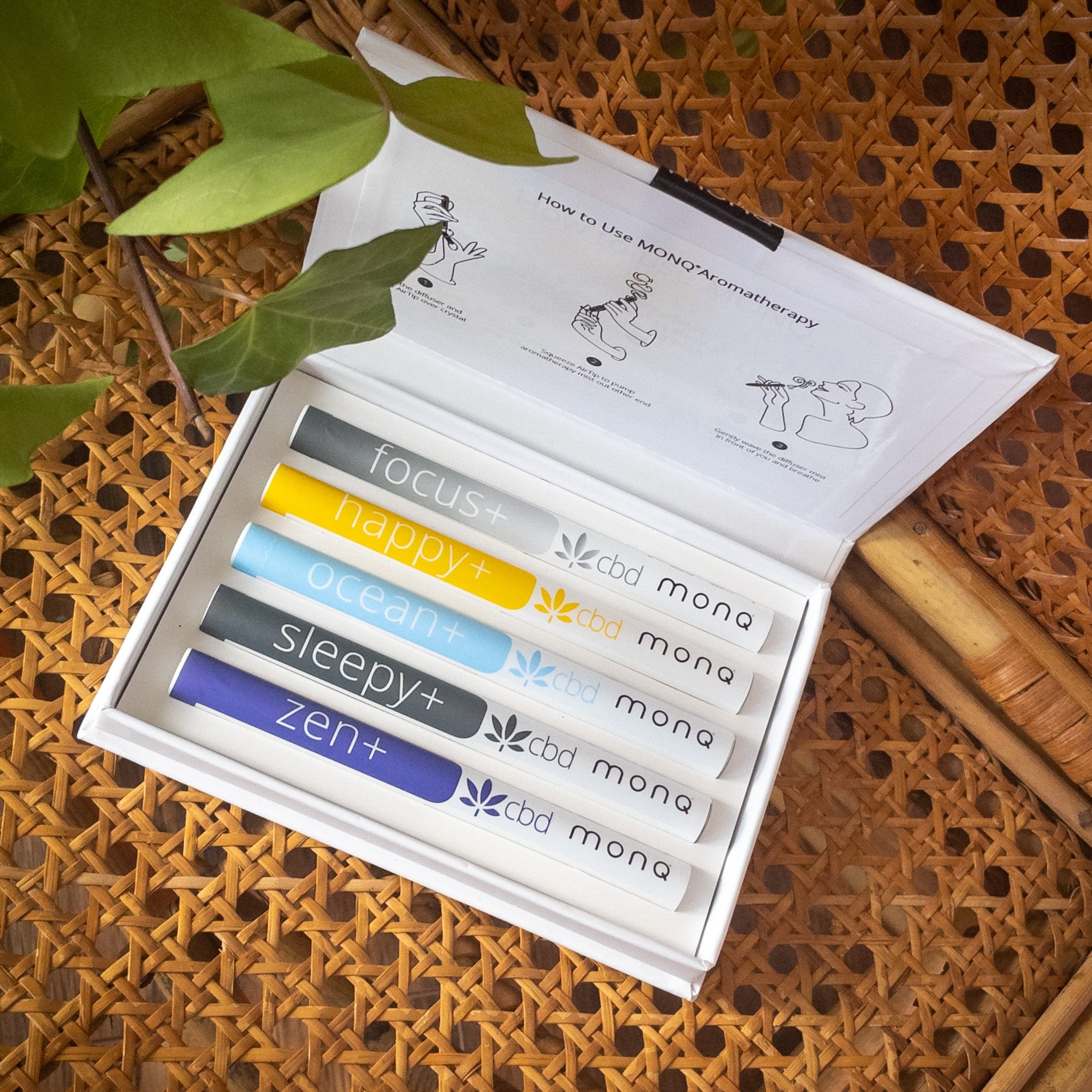
Fit the soft silicone AirTip over the crystal end of a MONQ Original diffuser. Hold the device in your hand and gently squeeze the AirTip to push air through the device and release a brief puff of aromatic mist from the mouthpiece near you. Breathe normally through your nose to enjoy the scent.

Why Breathing Technique Matters
Most room-based aromatherapy relies entirely on orthonasal olfaction. A diffuser fills a room with aromatic molecules, and you breathe them in through the nose in a normal breathing rhythm. This is pleasant and provides mild ambient benefit. But the concentration reaching the olfactory epithelium is low, the exposure is passive, and the effect is correspondingly gentle.
A personal aromatherapy device like MONQ changes the equation. By delivering the aromatic blend directly into the mouth and guiding it across the olfactory epithelium on the exhale, the concentration and directness of the delivery is substantially higher. Three intentional, correctly executed breaths produce a more focused olfactory experience than prolonged passive exposure to a room diffuser.
The full technique — and the science behind why it works — is covered in detail on our How to Use MONQ guide.

The Limbic Connection and Mood Response
Because olfactory signals reach the amygdala directly and rapidly, scent is uniquely positioned to influence emotional state. The amygdala processes the emotional valence of incoming stimuli — is this threatening or safe, aversive or pleasant — and initiates the appropriate physiological response. Scents associated with calm (lavender, chamomile) can prompt a mild parasympathetic shift. Scents associated with alertness (peppermint, rosemary) can prompt a mild sympathetic activation. These responses are real, measurable, and well-documented in the scientific literature on aromatherapy and olfaction.
MONQ blends are formulated with this pathway in mind — each blend pairing aromatic compounds whose individual profiles align with the intended mood state. Sleepy MONQ uses lavender, chamomile, and bergamot — all with calming aromatic profiles. Focus MONQ uses coffee, ginger, and rosemary — a trio associated with clarity and mental activation.
The connection between breathing, scent, and emotional state is one of the oldest therapeutic relationships in human history. MONQ's approach is to make that connection accessible, portable, and precise.
Disclaimer: The above information is provided for general wellness and educational purposes only. Please note that while individual essential oil ingredients may have been shown to exhibit certain independent effects when used alone, the specific blends of ingredients contained in MONQ diffusers have not been tested. No specific claims are being made that use of any MONQ diffusers will lead to any of the effects discussed above. Additionally, please note that MONQ diffusers have not been reviewed or approved by the U.S. Food and Drug Administration. MONQ diffusers are not intended to be used in the diagnosis, cure, mitigation, prevention, or treatment of any disease or medical condition. If you have a health condition or concern, please consult a physician or your alternative health care provider prior to using MONQ diffusers. MONQ blends should not be inhaled into the lungs. Why? It works better that way. No Nicotine Ever. Inhale through the mouth, exhale through the nose. MONQ Diffusers are not intended for individuals under 18, or women who are pregnant or nursing.










Leave a comment