

Why You Can't Sleep: 5 Common Causes and Aromatherapy Approaches
You're tired. You've been tired all day. You climb into bed, close your eyes - and nothing happens. Your mind speeds up instead of slowing down. Or you fall asleep quickly but wake at 3 AM and can't get back. Or you get a full 8 hours but still wake up feeling unrefreshed.
Sleep problems are among the most common health complaints worldwide. And unlike many health issues, they're rarely caused by one simple thing. Most sleep challenges have multiple contributing factors - and that means they often respond to multiple complementary approaches. Here are five of the most common causes of poor sleep, and how aromatherapy fits into a broader strategy for each.
1. Stress and Mental Tension
The body's stress response - mediated by cortisol and adrenaline - is designed to keep you alert and responsive to demands. It's excellent for performance. It's not compatible with sleep. When tension remains elevated in the evening, the physiological arousal it creates actively works against the conditions needed for sleep onset.
What it feels like: tightness in the body, racing thoughts, an inability to switch off, heightened sensitivity to sounds or light, a feeling of alertness even when you're exhausted.
Aromatherapy approach: Several essential oils have traditional associations with calming the tension response. Lavender, bergamot, and chamomile are among the most studied and most commonly used for this purpose. The olfactory-limbic pathway means that scent can reach the emotional centers of the brain quickly - a useful property when the goal is to interrupt a tension cycle before bed.
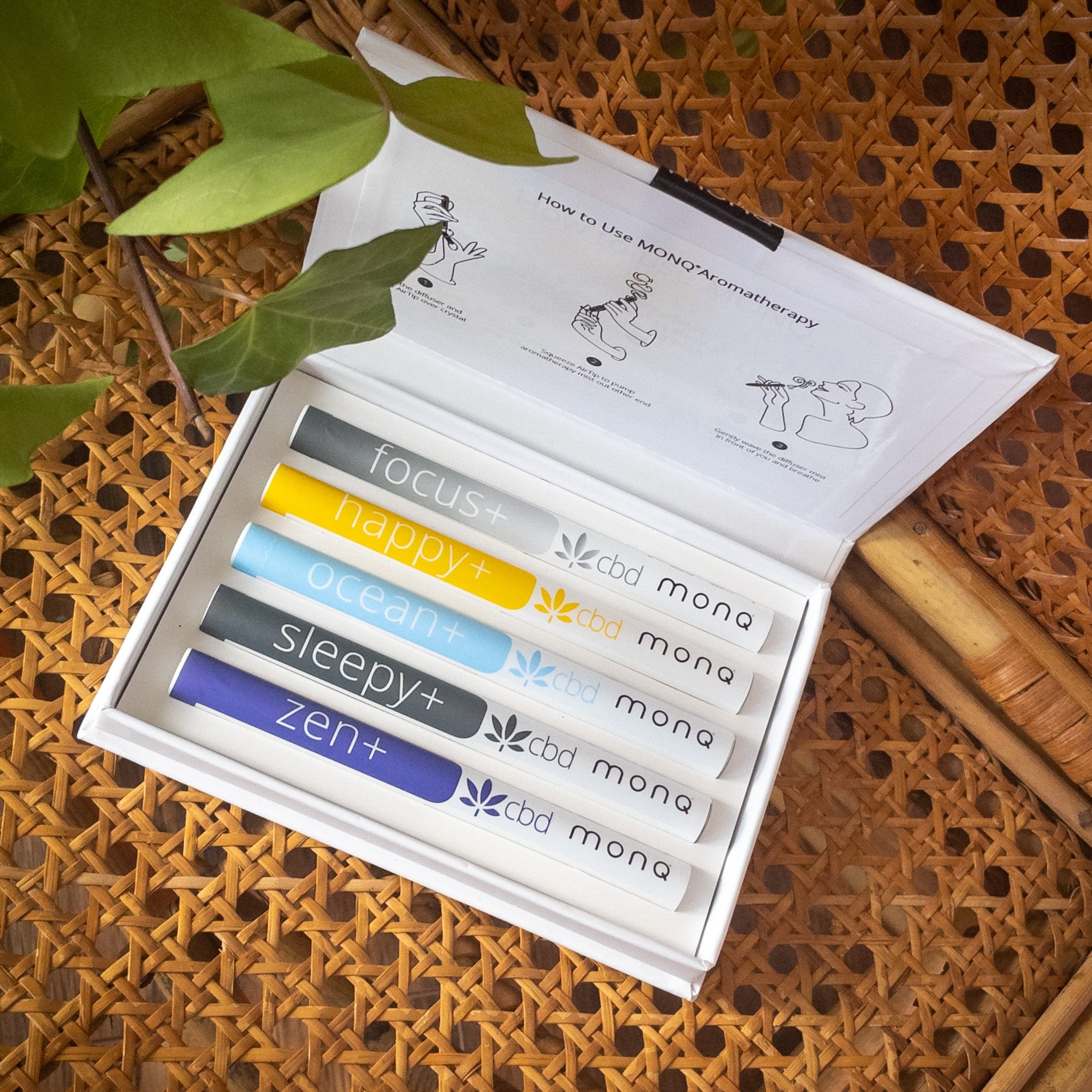
Many people find that a consistent aromatherapy ritual in the hour before bed - using the same scents in the same context - gradually becomes a reliable cue for shifting out of an activated state. Sleepy MONQ, with its blend of lavender, chamomile, and bergamot, is specifically formulated to support this kind of transition.
2. Screen Exposure and Blue Light
The screens on our phones, tablets, and computers emit blue-spectrum light that closely resembles daylight. Your brain uses light cues - specifically, the transition from bright blue light to dimmer, warmer light - to regulate melatonin production and circadian timing. Evening screen use effectively tells your brain it's still mid-afternoon.
What it feels like: difficulty feeling sleepy even at a late hour, a second wind after looking at your phone, delayed sleep timing, a general sense that your body isn't ready for sleep even when the clock says it should be.
Aromatherapy approach: Aromatherapy won't reverse the effects of blue light exposure, but it can serve as a competing cue - a strong sensory signal that it's time to wind down. Using a distinct sleep-oriented scent that you only use at bedtime creates a context that works against the alerting effects of recent screen use. The key is pairing the scent ritual with active screen reduction, not as a substitute for it.
3. Irregular Sleep Schedule
Your circadian rhythm is a roughly 24-hour internal clock that regulates virtually every physiological process, including sleep pressure, hormone secretion, body temperature, and alertness. This clock is entrained by light, temperature, and behavioral cues. When your sleep and wake times vary significantly day to day, the clock loses its precision - making it harder to feel sleepy at the right time and to sleep through the night consistently.
What it feels like: feeling wired on nights when you want to sleep early, being unable to sleep in even when you're tired. The feeling of mild jet lag without having traveled anywhere.
Aromatherapy approach: Scent can function as a zeitgeber - a German term meaning time-giver, describing external cues that help set the circadian clock. When you use the same scent at the same time every evening, you're adding a consistent sensory signal to the mix of cues that help regulate your internal timing. Used over weeks and months, bedtime aromatherapy may support the brain's recognition that now is sleep time.
4. Environmental Factors
Your sleep environment - temperature, light, sound, air quality, comfort - directly affects sleep quality. A bedroom that's too warm disrupts the natural drop in core body temperature that accompanies sleep onset. Noise from traffic, a partner, or nearby appliances can cause frequent micro-awakenings that fragment sleep even when you don't fully rouse to consciousness.
What it feels like: waking frequently through the night, feeling physically uncomfortable, light and easily disturbed sleep, waking unrefreshed despite adequate hours in bed.
Aromatherapy approach: While aromatherapy can't replace environmental optimization, scent plays a meaningful role in creating a sleep-associated context. A bedroom that consistently smells of lavender or cedarwood begins to register as "sleep space" to the brain - the environmental scent cue becomes part of the signal set that says rest is appropriate here. This pairs well with temperature control, blackout curtains, and sound management for a fully optimized sleep environment.
5. Racing Thoughts and a Busy Mind
For many people, the biggest obstacle to sleep isn't physical at all - it's mental. The mind continues processing the day's events, rehearsing tomorrow's challenges, cycling through unresolved concerns, or simply running through lists. The body may be exhausted while the mind remains fully engaged.
What it feels like: lying awake with a busy internal monologue, thoughts jumping from topic to topic, a sense that your mind is working even when you want it to rest. Physical fatigue but mental wakefulness.
Aromatherapy approach: Chamomile and bergamot are particularly well-regarded for mental restlessness. Their aromatic compounds may support the shift from active mental engagement to a quieter, more receptive state. Combining aromatherapy with specific mental wind-down practices - writing down tomorrow's tasks, doing a brief body scan meditation, slowing the breath - can create a powerful compound effect. The scent serves as an anchor for these practices and helps signal the transition to rest.
Building Your Complementary Approach
The most effective approach to sleep support is usually multi-layered. No single intervention works for everyone, but combining consistent behavioral practices - regular schedule, light management, a wind-down routine, optimized environment - with complementary supports like aromatherapy creates conditions where good sleep becomes much more accessible.
Aromatherapy isn't a substitute for addressing the root causes of poor sleep, but as part of a thoughtful routine, it can be a genuinely useful tool. The key is consistency: the same scents, same timing, same ritual, night after night, building the neural association that makes sleep feel natural and expected.
For evidence-based resources on sleep, the National Sleep Foundation and NCBI/PubMed offer extensive research and practical guidance.
Want to go deeper?
Explore the full science behind aromatherapy and sleep in our comprehensive guide: Aromatherapy for Sleep: A Wellness Guide →
Disclaimer: The above information is provided for general wellness and educational purposes only. Please note that while individual essential oil ingredients may have been shown to exhibit certain independent effects when used alone, the specific blends of ingredients contained in MONQ diffusers have not been tested. No specific claims are being made that use of any MONQ diffusers will lead to any of the effects discussed above. Additionally, please note that MONQ diffusers have not been reviewed or approved by the U.S. Food and Drug Administration. MONQ diffusers are not intended to be used in the diagnosis, cure, mitigation, prevention, or treatment of any disease or medical condition. If you have a health condition or concern, please consult a physician or your alternative health care provider prior to using MONQ diffusers. MONQ blends should not be inhaled into the lungs. Why? It works better that way. No Nicotine Ever. Inhale through the mouth, exhale through the nose. MONQ Diffusers are not intended for individuals under 18, or women who are pregnant or nursing.











Leave a comment