

Scents That Make You Feel Like You're at the Beach
Close your eyes for a moment. Think about the last time you stood at the edge of the water, shoes off, the wind moving across your face. What do you smell? Salty air, warm sand, something bright and citrusy carried in from somewhere you cannot quite identify. You know the feeling. You just cannot name all the parts of it.

That is not a coincidence. It is chemistry, memory, and the biology of how your nose talks to your brain. And understanding it opens a door to something genuinely useful: the ability to carry that feeling with you, wherever you go.
Why Smell is the Most Powerful Memory Trigger You Have
Of all five senses, smell is the only one with a direct line to the limbic system, the part of the brain that governs emotion and memory. Visual cues travel through the thalamus before reaching the brain's memory centers. Smell does not. It connects directly to the amygdala and hippocampus, which is why a single scent can transport you to a specific afternoon fifteen years ago more vividly than a photograph can.
A study published in Chemical Senses confirmed what most people intuitively understand: scent-triggered memories are older and more emotionally intense than those triggered by sight or sound. Researchers found that when adults were prompted with olfactory, visual, and auditory cues, the memories brought on by scent dated back further in time and carried a stronger emotional charge.
The smell of the ocean, for many people, is one of the most reliably evocative scents there is. It connects to summers, freedom, rest, and the particular looseness that comes with being near water with nowhere you need to be.
What the Beach Actually Smells Like (The Science)
The iconic scent of saltwater and open air has a specific origin that most people have never heard of. A gas called dimethyl sulfide, produced by ocean-dwelling microorganisms as they break down organic matter, is largely responsible for what we recognize as "the smell of the sea." It is not the water itself, and it is not the salt. It is a byproduct of microscopic life doing its work beneath the surface.
Beyond that, beach scents layer. There is the vegetation lining the dunes, the warmth baking into the sand, the carry of whatever is blooming nearby. Coastal plants have evolved alongside salt air, and many of them produce terpenes and aromatic compounds that read to the brain as clean, open, and invigorating. These are the compounds that aromatherapy has worked with for centuries.
Clary Sage: The Coastal Note You May Not Have Noticed

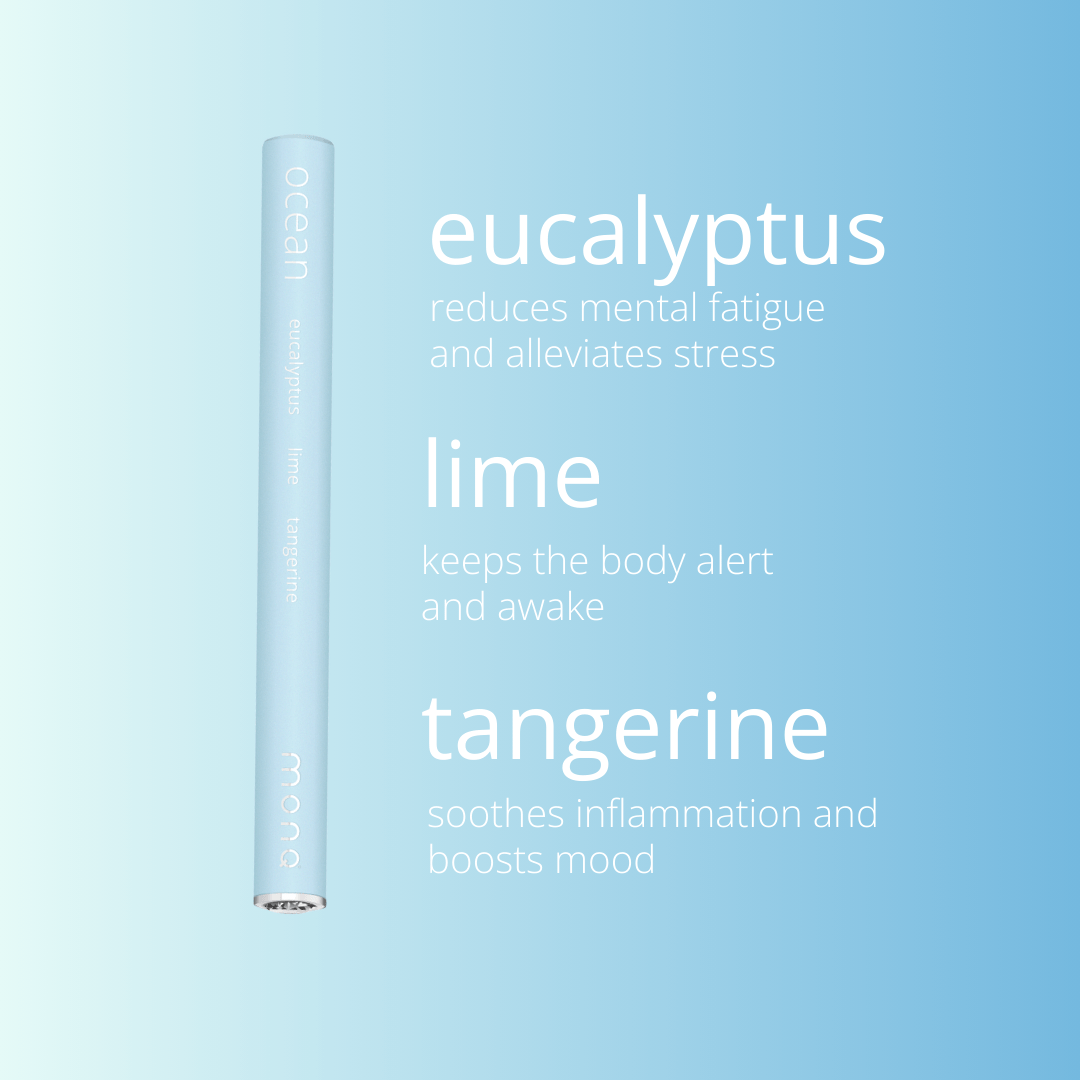
Ocean MONQ - the scent of the shore, in your pocket.
Among the botanicals in MONQ's Ocean blend is clary sage, a plant with a history stretching back to medieval Europe, where it was grown in herb gardens along coastal regions for its clarity-promoting properties. Its scent is earthy, slightly herbal, and soft, qualities that in a blend context serve as a grounding counterpoint to brighter notes above it.
Clary sage contains a compound called linalool, which occurs naturally across dozens of aromatic plants and is one of the more well-studied fragrance components in the scientific literature. It also carries a faint sweetness that coastal breezes often have, the kind that does not come from any single source but feels like it belongs to the air itself.
In MONQ Ocean, clary sage sits alongside eucalyptus, lime, and tangerine, with lemon, rosemary, spearmint, dill seed, and sage completing the blend. No single ingredient tells the whole story. They work together the way a coastline works: each element distinct, the whole inseparable.
The Scents That Actually Send People Back to the Shore
Olfactory nostalgia is personal. The specific scents that carry someone to the beach depend entirely on which beach, which season, and which decade. That said, certain aromatic families appear consistently in research and in the collective memory of people who grew up near coastlines:
- Citrus and fresh green notes, reminiscent of the tropical fruit being sold from a cart at a boardwalk, or the cold wedge of lime in a drink at a beach bar
- Earthy, herbal notes from coastal vegetation, grasses, and the dune plants that hold the sand in place
- Cool, camphoraceous notes from eucalyptus, which grows wild along many coastlines and releases its scent into the wind
- Soft, floral undertones from whatever is blooming in the salt air nearby
Eucalyptus in particular appears in almost every coastal region on earth in some form, and its distinctive fresh, slightly medicinal scent is deeply wired into what people recognize as "clean air near the water." It is the first thing many people notice about MONQ Ocean: a breath that feels genuinely open.
Bringing the Feeling Somewhere It Does Not Belong

The practical argument for aromatherapy rooted in coastal scent is simple. Most people cannot get to the ocean whenever they need to reset. The workday does not pause for long drives to the shore. The commute does not smell like anything worth remembering.
What aromatherapy offers in this context is not a simulation of the beach. It is a trigger for the state of mind the beach produced. There is a meaningful difference. You are not convincing yourself you are somewhere you are not. You are activating something already stored, a memory, a physical ease, a learned sense of what it feels like to breathe freely, using scent as the key.
MONQ Ocean was designed for exactly this use: a few slow breaths through a portable blend of botanical oils, inhaled through the mouth and exhaled through the nose, allowing the aromatic compounds to pass through the olfactory system directly. It fits in a pocket. It does not require a plug, a room, or a dedicated ritual.
It does require a moment. But that is the point.
Explore Ocean MONQ or read more about how plant evolution gave us aromatherapy and why you evolved to breathe plants.
Disclaimer: The above information is provided for general wellness and educational purposes only. Please note that while individual essential oil ingredients may have been shown to exhibit certain independent effects when used alone, the specific blends of ingredients contained in MONQ diffusers have not been tested. No specific claims are being made that use of any MONQ diffusers will lead to any of the effects discussed above. Additionally, please note that MONQ diffusers have not been reviewed or approved by the U.S. Food and Drug Administration. MONQ diffusers are not intended to be used in the diagnosis, cure, mitigation, prevention, or treatment of any disease or medical condition. If you have a health condition or concern, please consult a physician or your alternative health care provider prior to using MONQ diffusers. MONQ blends should not be inhaled into the lungs. Why? It works better that way. No Nicotine Ever in MONQ Pens. Inhale through the mouth, exhale through the nose. MONQ Diffusers are not intended for individuals under 18, or women who are pregnant or nursing.










Leave a comment